Dimensionality reduction maps a feature vector from D dimensions into a smaller D′-dimensional representation while preserving important structure. PCA provides a classic approach; autoencoders extend the same encoder–decoder idea with larger, more expressive networks. section 7.1.1 section 7.2
PCA can be viewed as a bottleneck autoencoder: a weight matrix encodes, its transpose decodes, and a reconstruction objective uses squared error with a constraint-related regularization penalty. Autoencoders commonly taper toward a bottleneck and expand back toward the input size. section 7.1.1 section 7.2
Reconstruction-based outlier detection
Train an autoencoder, compute reconstruction errors, and flag the highest-error cases using a threshold matched to the expected abnormal fraction. Poor reconstruction suggests that an input is unusual and may need review rather than prediction. section 7.2
Figure 7.4 Example of a standard autoencoder design. The input comes in on the left. The encoder starts out large and tapers down the size of the hidden layers at each step. Because autoencoders are usually symmetric, our decoder will receive the small representation z and begin expanding it back to the original size.
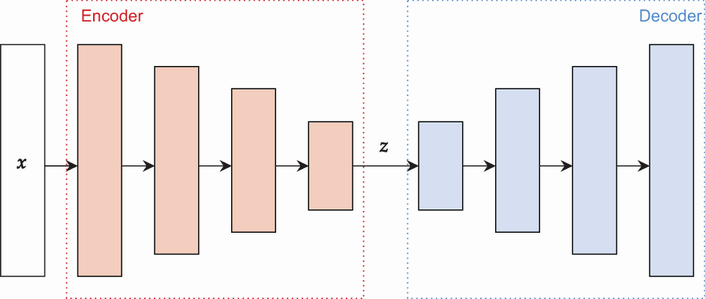
Shows the standard bottleneck layout: the encoder contracts toward representation z, while the decoder expands back toward the original input size. section 7.2










