A directed acyclic graph (DAG) models workflow steps as directed dependencies without any closed loop. A sequential workflow is therefore a simple DAG: execution proceeds from A to B to C, but no later step points back to an earlier one. section 5.1
In machine-learning production, DAGs describe workflows such as data ingestion, model training, and model serving. One ingestion step can feed multiple training steps, which can feed different serving steps as the workflow grows more complex. section 5.1
Use the dependency structure to:
- Represent which steps must finish before dependent steps begin. section 5.1
- Branch after a shared step and join multiple branches at a later step. section 8.4.1
- Reject cyclic designs: adding an edge from D back to A closes the loop and makes the workflow invalid. section 5.1
Diamond workflow in Argo
A starts the workflow; B and C depend on A; D depends on both B and C. Argo Workflows expresses these dependencies in Kubernetes and creates a Pod for each task. section 8.4.1
Figure 5.1 A diagram showing a simple machine learning workflow, including data ingestion, model training, and model serving. The arrows indicate directions. For example, the arrow on the right-hand side denotes the order of the step execution (e.g., the workflow executes the model serving step after the model training step is completed).
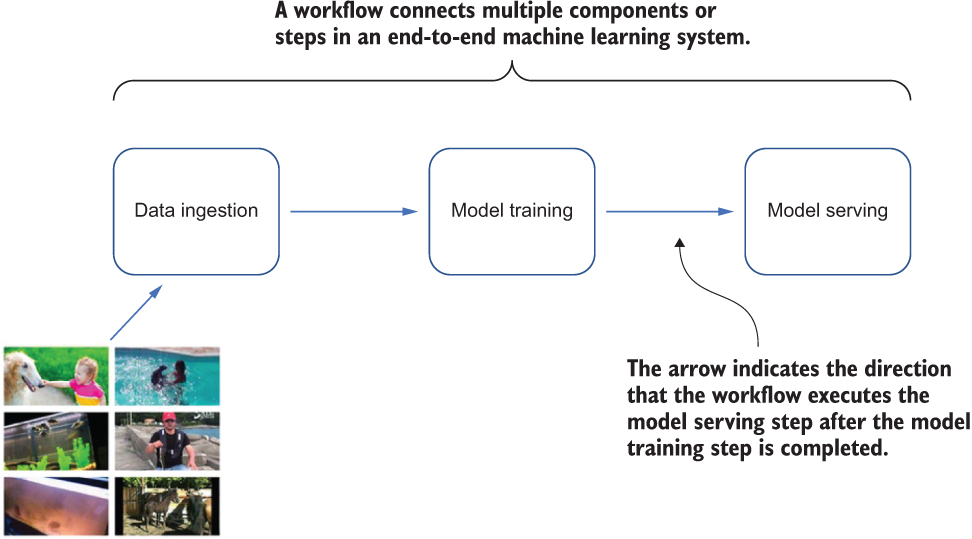
Trace a simple machine-learning DAG from data ingestion through model training to model serving; arrows show dependency and execution order. section 5.1














