A directed acyclic graph (DAG) represents a data pipeline as tasks connected by one-way dependencies, with no cycle. A workflow engine invokes the tasks in sequence without requiring a loop. section 4.3.3
In an ELT workflow, separate tasks can load tables from different systems, join them, and remove null values. Each task may contain internal steps or invoke another workflow, while the pipeline engine abstracts execution and management across technical stacks. section 4.3.3
Figure 4.1 An example DAG: it’s directed (D) as the information flows one way along the arrows. It’s acyclic (A) because there aren’t any cycles, and it’s a graph (G) because that’s what this sort of thing is called.
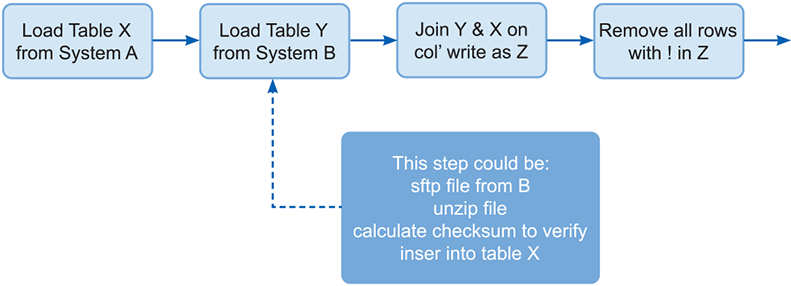
Use the DAG figure to distinguish directed information flow, acyclicity, and the graph structure. section 4.3.3














