Domain knowledge is command of a field’s vocabulary, facts, standards, practices, and reasoning conventions. For language models, it means more than retrieving relevant documents: it includes the contextual judgment and analytical patterns developed through focused exposure to domain tasks. section 1.2.2 section 2.3.3
A general-purpose model may reason fluently while missing professional nuance. Specialized models can combine private data, expert feedback, and organization-specific terminology and processes to produce guidance aligned with institutional standards. section 1.3.3 section 2.3.3
Treat domain knowledge as a model-selection and adaptation concern:
- Separate information access from expertise: RAG can supply retrieved material, but does not itself create domain-trained reasoning patterns. section 1.2.2
- Inspect a base model’s prior domain exposure before fine-tuning; adaptation refines existing grounding more efficiently than learning an unfamiliar field from scratch. section 2.3.3
- Evaluate subject-matter understanding separately from task performance, including terminology, standards, and contextual subtleties. section 2.3.3
Credit risk assessment
Financial ratios, regulatory thresholds, and institutional policies can be embedded through fine-tuning so a model applies organization-specific borrower scoring rules and generates structured, justified risk assessments consistently. section 2.1
Biomedical question answering
General-purpose models may give fluent biomedical answers while missing medical terminology or context. A model pretrained on biomedical research can start with stronger subject-language grounding before further fine-tuning. section 2.3.3
Figure 1.3 RAG process. It requires preprocessing the documents and storing them in a vector store, where chunks are paired with their vector representations and other metadata. The answering process is split into two phases: retrieval and generation. The first searches for chunks like the question; the second generates an answer by passing the retrieved documents to the LLM.
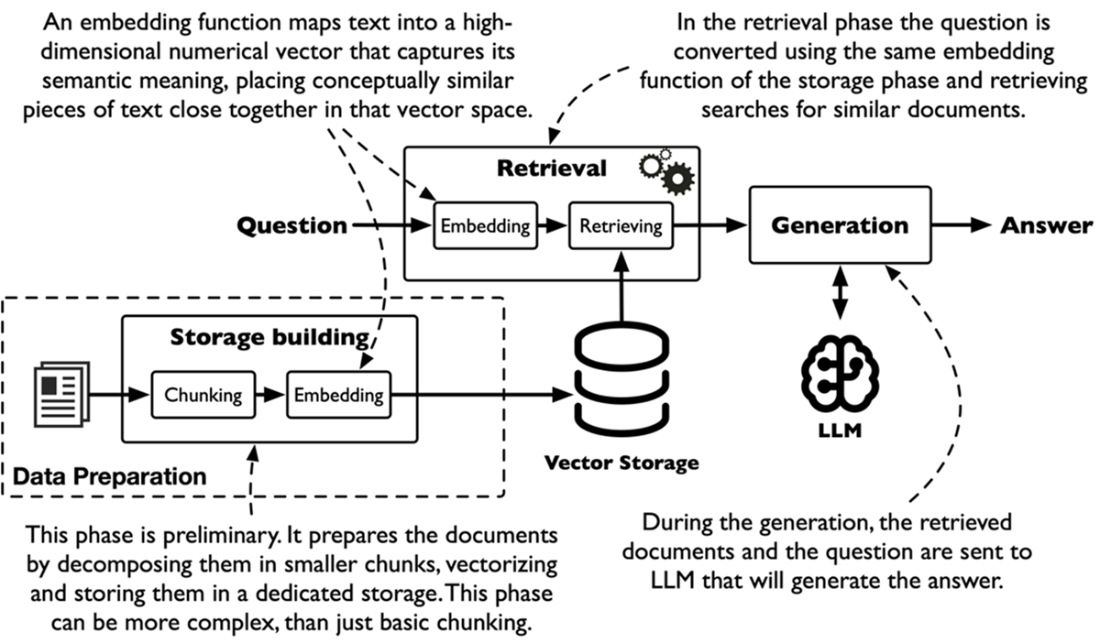
Use the RAG process diagram to distinguish retrieving domain documents from developing domain expertise: retrieval supplies chunks to generation, whereas specialization changes the model’s learned capabilities. section 1.2.2