Domain knowledge connects analysis to the real-world mechanisms behind the data. In causal inference, it determines whether stone size causes treatment choice or treatment changes stone size, setting the direction of the causal graph. section 2.1.1
Prediction and accuracy do not replace subject-matter judgment. Analysts use domain knowledge to identify plausible confounders, decide which variables belong in a model, and avoid selecting variables merely because they improve predictive performance. section 5.3.2 section 2.9
Use domain knowledge to:
- Construct a directed acyclic graph that represents relevant causal relationships. section 3.1
- Distinguish measured confounders from relevant factors that remain unknown or unavailable. section 2.9
- Choose adjustment variables using causal structure rather than model accuracy alone. section 5.3.2 section 7.8
- Check whether the available data support the intended causal question, including positivity. section 2.9 section 3.1
Kidney-stone treatment
Doctors assign larger, harder-to-treat stones to treatment A and smaller stones to treatment B. Without medical knowledge, the treatment-group difference could be mistaken for a treatment effect. The resulting graph identifies stone size as a confounder and indicates whether adjustment is required. section 2.1.1 section 3.1
Figure 2.1 The sizes of kidney stones vary between treatments. Larger stones, which are more challenging cases, tend to receive treatment A, whereas smaller, easier cases are often assigned to treatment B. In both scenarios, the distribution of stone sizes differs significantly from the overall distribution.
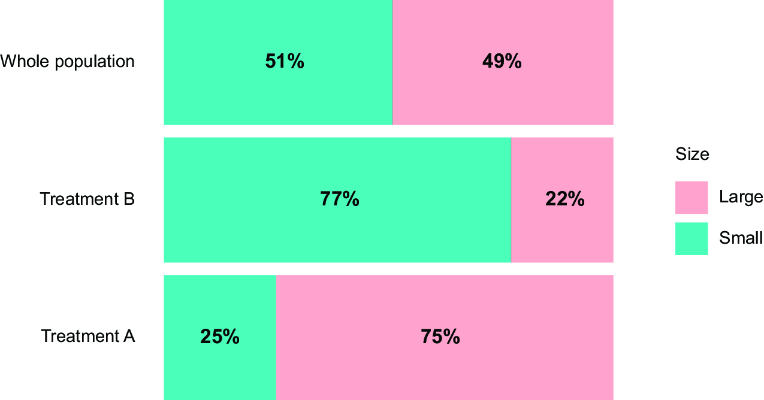
Compare the stone-size distributions across treatments to see how treatment groups can contain systematically different cases. section 2.1.1
















