A search engine needs more than matching words when the same phrase can mean different things in different domains. Domain knowledge gives it a way to interpret the concepts, entities, labels, and relationships specific to the content being searched. Alongside content understanding and user understanding, it helps the engine infer what a query is asking for. section 1.2.5 section 2.5.2
Domain knowledge can enter a search pipeline through several related components:
- Alternative labels, synonyms, taxonomies, and ontologies describe domain terms and their relationships; a knowledge graph can bring these representations together. section 2.7
- A query pipeline can identify concepts and entities, correct misspellings, add related terms, and rewrite the query before retrieval. section 1.3.7
- Batch jobs can learn from content and user signals, preparing information that must be available quickly when a query arrives. section 1.3.7
From an entered query to a domain-aware query
Suppose a query contains a known entity and a misspelling users commonly make. A pipeline can use its entity list and users’ previous spelling choices to recognize the intended terms, then rewrite the query for retrieval. Without that context, keyword matching may treat the entered words only as separate strings. If the interpretation is uncertain, basic keyword search remains a useful fallback. section 1.2.5 section 1.3.7 section 2.5.2
Domain knowledge supports semantic search when combined with keyword matching. User preferences add another dimension: they can personalize results without replacing the need to understand the query and documents. General-purpose LLMs may help interpret language, but information absent from their training data may require adaptation to the domain. section 1.2.5 section 2.6
Figure 1.7 The dimensions of user intent: a combination of content understanding, user understanding, and domain understanding
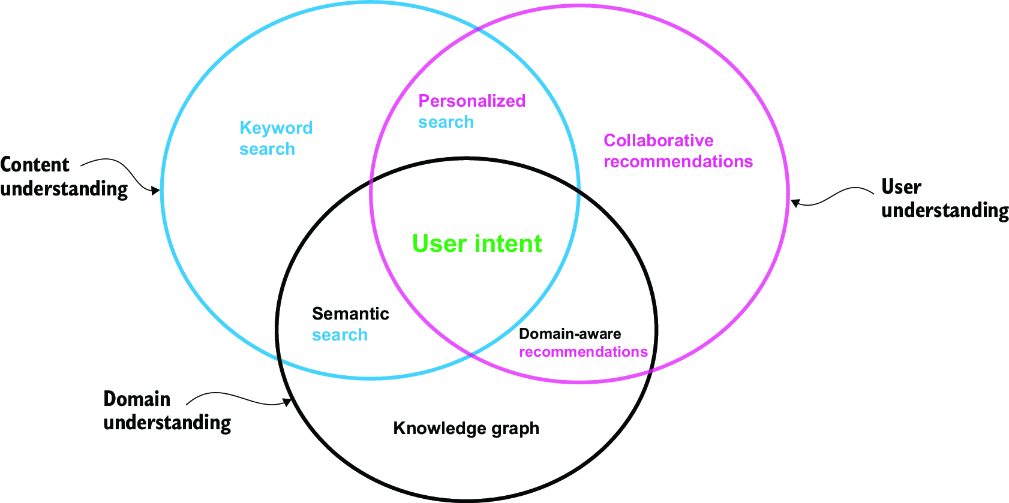
The three-circle diagram separates domain understanding from content and user understanding, then shows where their combinations support semantic and personalized search. section 1.2.5
















