Migration moves workloads from virtual machines or other execution environments into containers and deploys the resulting artifacts on a compatible GKE or Anthos cluster. It offers an incremental modernization path when rewriting legacy applications is impractical or too expensive. section 2.4.6 section 16.6
Prioritize workloads with these characteristics:
- Stateless web frontends that benefit from lightweight, independently scalable containers. section 15.2
- Multitier web applications, middleware, and commercial software that can be separated into independent containers. section 15.2
- Medium-to-large databases whose data layer can be separated from compute, including MySQL, Postgres, and Redis. section 15.2
- Bursty, low-duty-cycle, development, training, and lab workloads where rapid provisioning matters. section 15.2
A practical migration has three phases: setup, migration, and optimization. Setup creates a processing cluster, registers a migration source, establishes the cloud landing zone, and discovers candidate workloads. Migration generates container images, a Dockerfile, data volumes, and deployment YAML; data is moved and synchronized automatically. Optimization tests and adjusts the generated artifacts before deployment. section 15.3.1
Containerizing an Apache VM
A GCE VM running Apache can be registered as a migration source, converted into container artifacts by a separate Kubernetes processing cluster, and deployed to GKE. The operational sequence creates source credentials, installs Migrate for Anthos, creates and validates a migration plan, generates and downloads artifacts, then applies the deployment specification with kubectl. The resulting service can expose the migrated web server through a load balancer. section 15.4.2
Windows workloads follow the same migctl workflow, with a Windows workload type and artifacts staged in Cloud Storage. The downloaded package includes a Dockerfile and deployment specification that can be expanded, built, and pushed to Container Registry. section 15.4.4
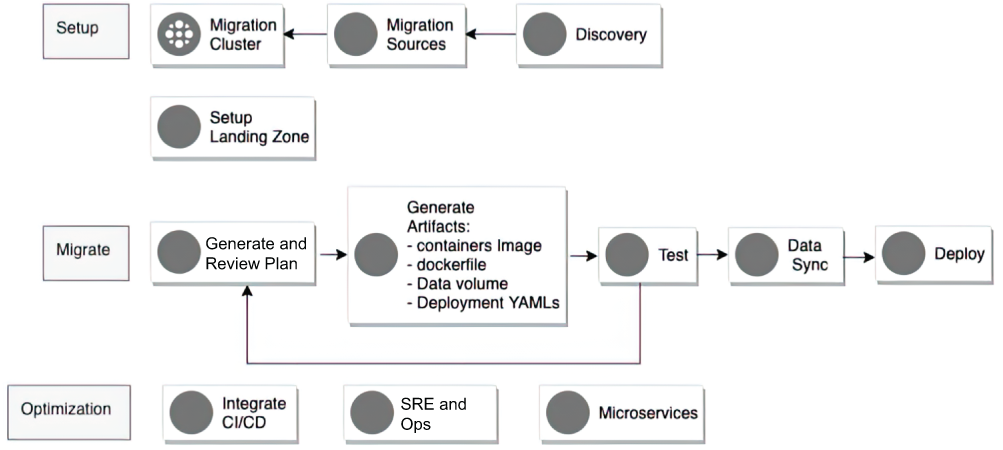
Use the workflow diagram to track setup, migration, and optimization as a connected operational process. section 15.3.1


















