A lending agent encounters an application outside its authority: confidence falls below 0.75, exposure exceeds its approval limit, or documents conflict. The agent stops, transfers the decision and its context, and a human reviewer takes over. This is human-in-the-loop (HITL): human judgment is embedded at a defined decision surface. section 4.2.1
HITL differs from human-on-the-loop (HOTL), a supervisory pattern in which the agent continues within defined bounds while a named human monitors performance and intervenes when risk or drift appears. Both retain human accountability, but attach it at different points. section 4.2 section 4.2.2
Figure 4.4 Oversight postures at a decision surface. In Human-in-the-Loop (HITL), human authority is embedded directly in the decision surface and triggered by individual cases. In Human-on-the-Loop (HOTL), the value stream remains autonomous within defined confidence bands, while a supervisor monitors and intervenes at the portfolio level.
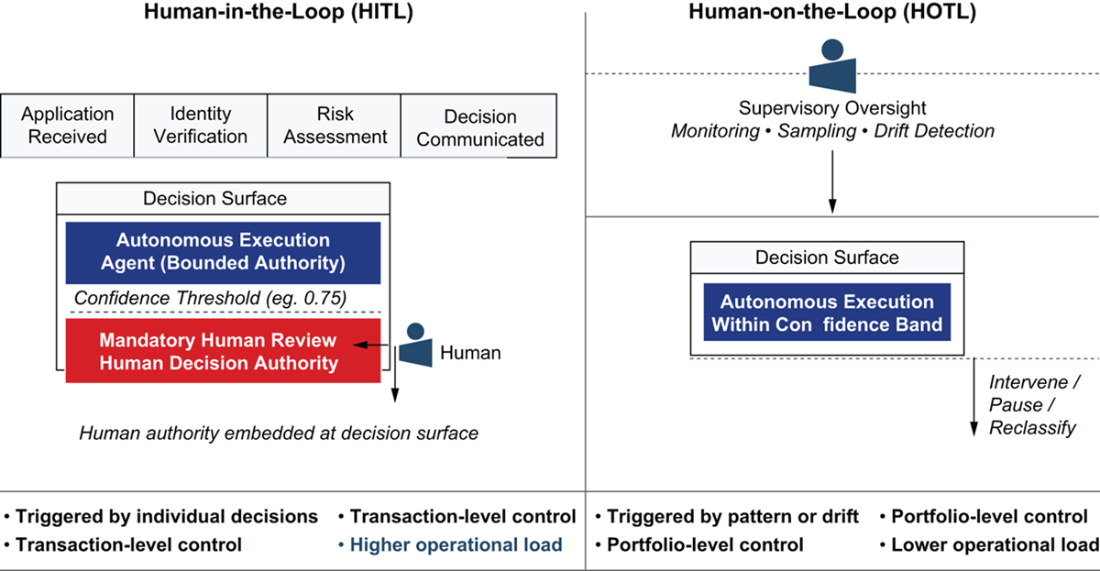
Compare embedded case-level review with portfolio-level supervision at a decision surface. section 4.2
Design the transfer of authority explicitly:
- Define triggers for low confidence, policy conflict, and consequences beyond delegated risk tolerance. Confidence cannot override a policy constraint. section 4.2.4
- Pause the flow, preserve its state, and route the decision and relevant context to a human reviewer. Authority must transfer with enough information to act. section 6.6.2 section 2.2.2
- Test triggers before deployment, validate handovers with reviewers under time pressure, and model escalation volume against reviewer capacity. Persistent overload calls for architectural adjustment, not bypassing thresholds. section 4.2.1
Choose HITL when a single unreviewed decision could cause a regulatory finding, material financial loss, or an irreversible customer outcome. HOTL can suit high-volume decisions with recoverable individual errors, provided systemic drift and policy deviations are detected. Revisit the choice as performance, scope, models, or operating conditions change; do not select supervisory oversight merely to save reviewer capacity. section 4.2.3 section 4.2.2