JSON (JavaScript Object Notation) is a lightweight, widely used format for exchanging structured data between applications. It makes each value’s meaning explicit by pairing a field name, or key, with its value. Braces form an object, brackets represent arrays, and values can be text or numbers. section 7.2
A small customer record
A row containing Tessa and 15 can be represented as {"Name": "Tessa", "Age": 15}. The keys Name and Age label the values, so a receiving application or LLM can tell what each value represents. section 7.2
To prepare structured customer context for an LLM:
- Select only the fields relevant to the task, such as FirstName, Age, City, purchase totals, and time since the last purchase. section 7.2
- Combine those fields as key-value pairs into one JSON object, rather than sending an unlabeled sequence of words and numbers. section 7.2
- Exclude unnecessary identifiers or details, such as CustomerID or LastName, when they do not help generate the result. section 7.2
Figure 7.22 The Columns to JSON node generates a single object embedding all the columns you need.
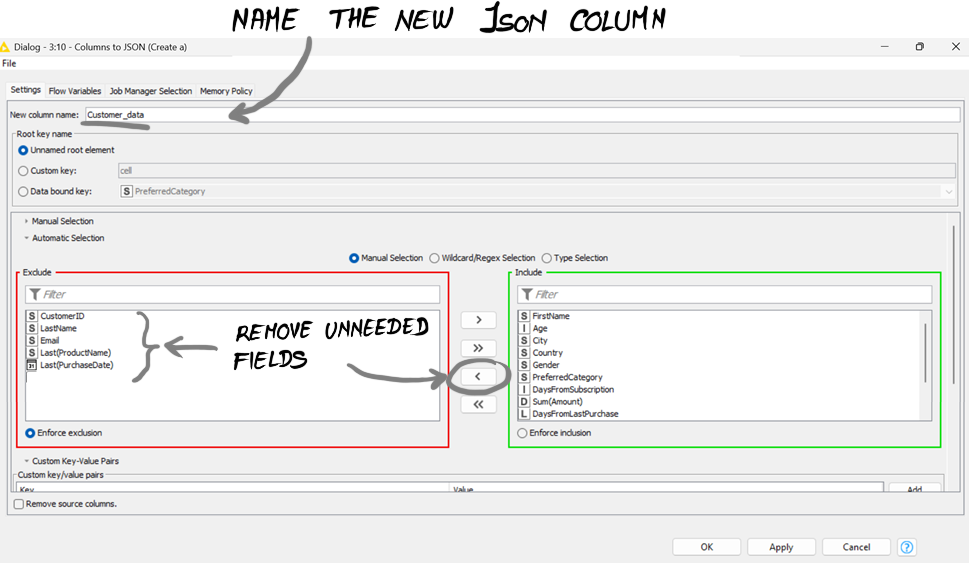
A Columns to JSON configuration combines selected table columns into one JSON object. section 7.2


































