liveBook · Manning

Logit

As explained in Applied Reinforcement Learning

A logit is an unnormalized real-valued score that softmax transforms into an action probability.

A logit is a raw score for an available choice. Softmax converts a set of logits into probabilities, which a policy can use to sample an action. section 9.3

Choosing a production level

For Low, Medium, and High production, logits [1.0, 2.5, 0.5] become probabilities of 0.17, 0.76, and 0.10. The policy samples an action; a good return can increase the chosen action’s probability. section 9.3

In language generation, logits score possible next tokens. Decoding turns those scores into probabilities and selects a token, either by choosing the highest-probability option or sampling. section 10.2

Figure 10.1 Overview of large language models architecture.
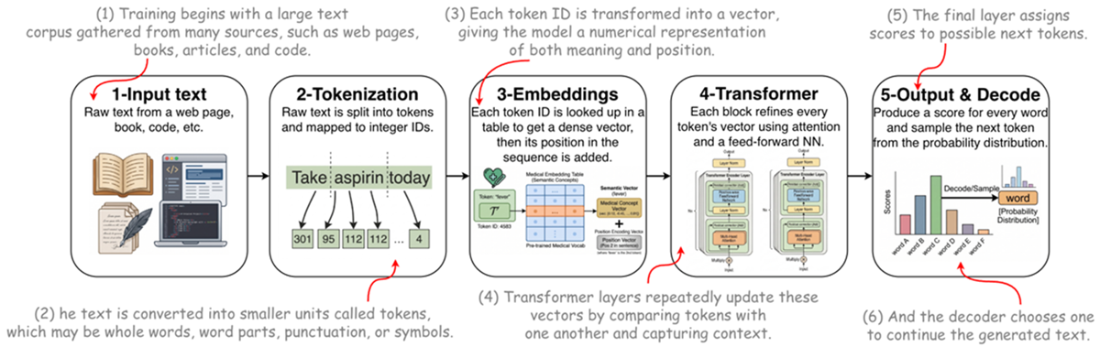
The architecture figure situates next-token logits at the output stage of language generation. section 10.2


How Applied Reinforcement Learning covers it

How deep it goes
Defines raw scores and works through softmax probabilities, action sampling, and policy updates.
Examples
Calculates production-level probabilities from three logits and describes selecting a next token from language-model scores.
What you can do after
Apply softmax to convert action scores into probabilities and sample an action.
How it connects
Connects logits to softmax, categorical policies, action sampling, and language-model decoding.

Also explained in

Compare how 24 books explain logit →

Related concepts

This explainer was generated by Manning's knowledge graph from the text of Applied Reinforcement Learning. The section links point to the parts of the book it draws on.





















