liveBook · Manning

Moore's law

As explained in Fast Python: High performance techniques for large datasets

Moore’s law is the empirical observation that the number of transistors on an integrated circuit historically tended to double approximately every two years.

Moore’s law describes transistor density doubling about every two years; it does not mean processor speed doubles at the same rate. Compared with data-transfer rates doubling every 18 months, it suggests a growing gap between data to process and computing capacity. That comparison can overstate hardware progress: transistor density stopped translating linearly into speed, and CPU speeds have mostly plateaued as manufacturers add parallel execution instead. section 1.1 section 1.2.1

Figure 1.1 The ratio between Moore’s law and Edholm’s law suggests that hardware will always lag behind the amount of data being generated. Moreover, the gap will increase over time.
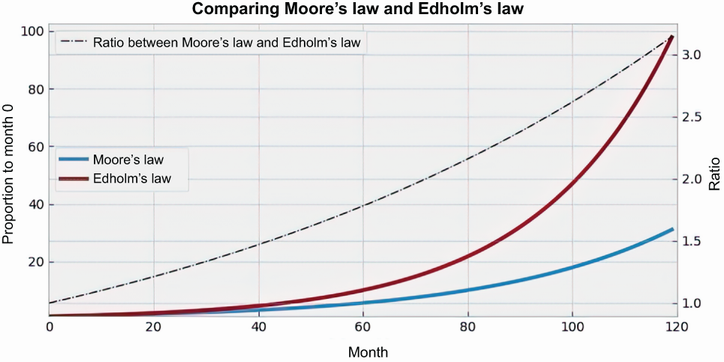
Compare the growth of data-transfer rates with transistor density to see the widening gap between data growth and computing capacity. section 1.1


How Fast Python: High performance techniques for large datasets covers it

How deep it goes
Defines transistor-density growth and corrects the speed-doubling misconception, but stops short of detailed modern CPU architecture.
Examples
Compares plotted data-transfer and transistor-density growth, alongside internet-traffic growth over time.
What you can do after
Understand why rising transistor density no longer guarantees faster sequential computation and why parallel execution matters.
How it connects
Connects Edholm’s law, transistor density, CPU performance, and parallelism.

Also explained in

Compare how 4 books explain Moore's law →

Related concepts

This explainer was generated by Manning's knowledge graph from the text of Fast Python: High performance techniques for large datasets. The section links point to the parts of the book it draws on.

