Moore's law is the observation that transistor counts on integrated circuits historically doubled about every 18 to 24 months. It describes a trend, not a guarantee of equal growth in overall computing power. section 7.1.1
Transistor counts can keep rising while frequency, power, single-threaded performance, and total computing grow more slowly. Costs, power, data, and infrastructure create diminishing returns, so bigger hardware cannot deliver boundless improvement. section 7.1.1
A misleading shortcut
If a chip moves from 10 billion to 20 billion transistors, Moore's law describes that increase. It does not prove that the whole system became twice as fast, because other constraints may limit performance. section 7.1.1
Figure 7.3 Moores’s law is a common example of boundless growth, but it is misleading. Transistors keep doubling, but frequency, power, single-threaded performance, and total computing do not. So the total system performance has not continued to double approximately every two years. Other similar factors will constrain LLM performance and affect capability over time. Used under CC4.0 license from https://github.com/karlrupp/microprocessor-trend-data.
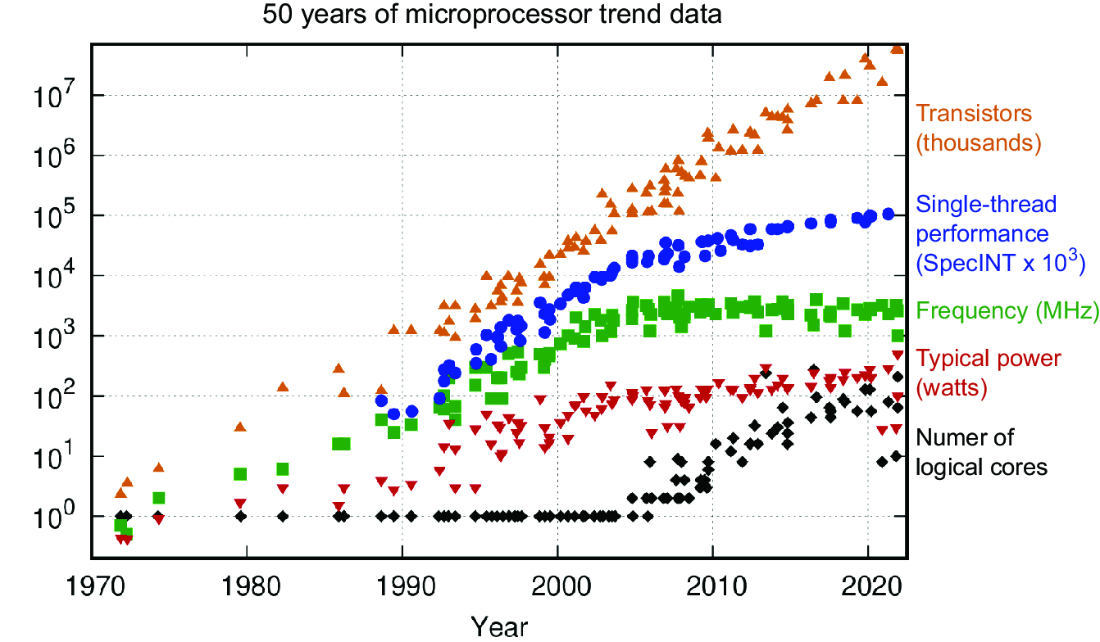
Compare transistor growth with frequency, power, single-threaded performance, and total computing to see why the trend can mislead. section 7.1.1



