Normalization transforms data values into a common representation so variables become comparable. In dimensionality reduction, it prepares numerical data before methods such as PCA or SVD. section 3.11 section 3.5
A normalized dataset supports the following PCA workflow:
- Normalize the dataset first so variables share a comparable representation. section 3.5
- Convert categorical variables to numeric forms before applying dimensionality-reduction algorithms. section 3.11
- Calculate covariance, then use eigenvectors and eigenvalues to select components capturing maximum variance. section 3.5
House-price variables
A principal component can combine variables such as area, bedrooms, distance, and schools into a new variable, making a complex dataset easier to analyze. section 3.5
(3.1)
new_variable = a*area – b*bedrooms + c*distance – d*schools
Inspect a concrete linear-combination equation showing how several variables can form a new component after preparation. section 3.5
Figure 3.8 The first figure on the left is the first principal component. The second principal component can be at different angles with respect to the first principal component (middle). We should find the second principle that allows us to capture the maximum variance. To capture the maximum variance, the second principal component should be orthogonal to the first one, and thus the combined variance captured is maximized (right).
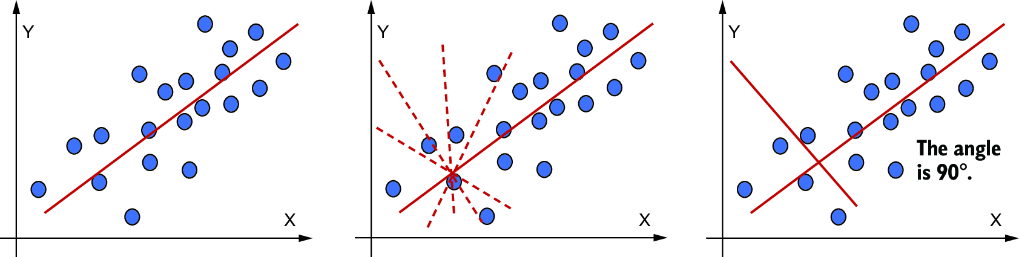
Use the diagram to see how successive orthogonal components maximize the variance captured from normalized data. section 3.5




















