Normalization transforms numeric features so their values fit a specified scale or distribution. In a training pipeline, it is a preprocessing step alongside cleaning, feature engineering, and time-aware train–test splitting. section 10.6.1 section 11.1.2
Use normalization deliberately rather than treating every model the same:
- Check the model family before transforming features; monotonic transformations may not improve gradient boosting because decision trees are invariant to them. section 11.1.2
- Keep normalization inside the preprocessing workflow, with train–test separation performed by time when working with temporal data to reduce leakage risk. section 10.6.1
- Distinguish normalization from related transformations such as logarithms for skewness, lags and aggregates for time series, and quantile bucketing for discrete categories. section 11.1.2
Retail forecasting pipeline
A retail forecasting workflow scales numeric sales-related features to a standard range before training baseline forecasting methods, tree ensembles, support vector machines, or deep-learning models. The transformation belongs in preprocessing, before model evaluation and business-cost analysis. section 10.6.1
Figure 11.1 An overview of the DeepETA model pipeline: example of combining base feature engineering and a deep learning model (source: https://mng.bz/0MoN)
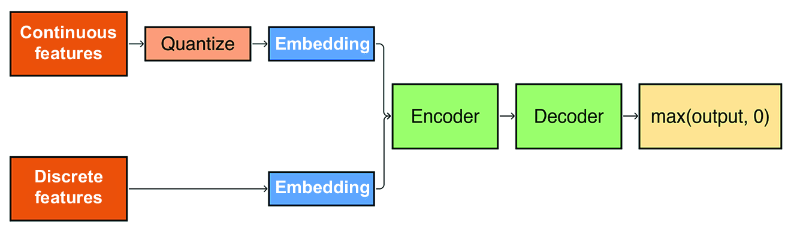
Use the DeepETA pipeline as a broader feature-transformation example: continuous, categorical, and geospatial inputs become discrete tokens and learnable embeddings for a transformer. section 11.1.2




















