liveBook · Manning

Observability

As explained in Building Distributed Applications that Work

Observability is the capability to infer the internal behavior and condition of a system from its externally emitted telemetry.

Observability makes a distributed application’s behavior visible through logs, metrics, and distributed traces. When a request crosses independently running components, these signals help verify the complete workflow and diagnose failures across service boundaries. section 1.1

Following an order

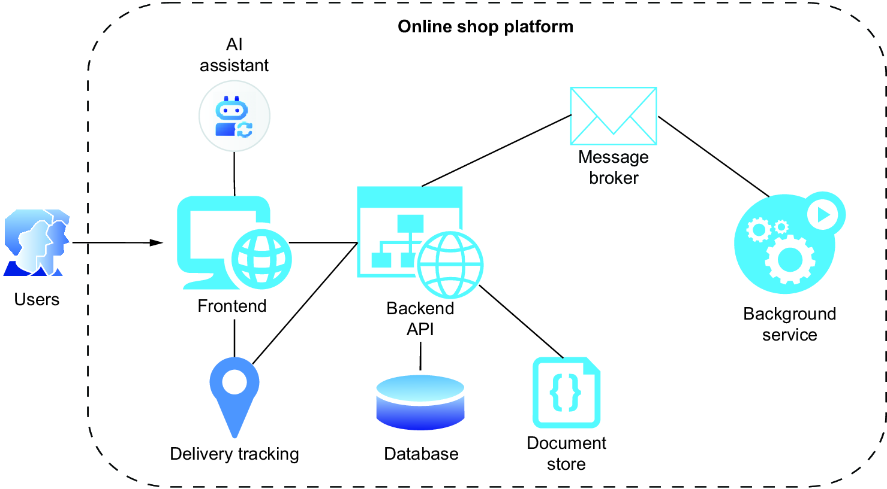
A shopper’s request moves through the storefront, API, data stores, and background processing. Tracing helps follow that request across services; logs and metrics provide further evidence when processing fails or slows down. section 1.1 section 1.4

Aspire integrates with OpenTelemetry to provide tracing, logging, and metrics without extensive manual instrumentation. Its dashboard helps make system behavior visible during local development. Treat that visibility as part of the application, alongside explicit configuration and infrastructure. section 1.4 section 10.5

Figure 1.1 A shopper’s request crosses the storefront, API, data stores, and background-processing components. Telemetry makes the complete workflow observable.
figure

Follow the shopper’s request across components to see why observing one service alone cannot explain the whole workflow. section 1.1


How Building Distributed Applications that Work covers it

How deep it goes
Identifies logs, metrics, and distributed traces and explains their diagnostic role, but does not specify instrumentation steps here.
Examples
Follows a shopper’s request through a storefront, API, data stores, and background-processing components.
What it assumes
Introduces the need for telemetry through a multi-component workflow before building on distributed-systems concepts.
What you can do after
Diagnose/debug with it by following requests across services and identifying failures or performance bottlenecks.
How it connects
Connects observability to distributed tracing, integration testing, microservice orchestration, and performance monitoring.

Also explained in

Compare how 16 books explain observability →

Related concepts

This explainer was generated by Manning's knowledge graph from the text of Building Distributed Applications that Work. The section links point to the parts of the book it draws on.













