Observability is the capability to infer a system’s internal state from externally available signals and use that understanding to influence the system. It forms a feedback loop: sources emit signals, agents collect and process them, and destinations expose them to people or applications. section 1.1 section 1.6
A practical observability workflow connects:
- Sources such as microservices, databases, message queues, devices, operating systems, and application code. section 1.1
- Signals such as logs, metrics, and traces, which provide externally visible information about system behavior. section 1.1
- Agents that collect, preprocess, route, and correlate telemetry before ingestion. section 1.1 section 1.6
- Destinations such as dashboards, alerts, long-term storage, and analytics, where humans or applications consume actionable insights. section 1.1
Observability helps teams understand code changes, third-party dependencies, user experience, service health, performance, costs, developer productivity, and incident blast radius. In distributed and volatile cloud-native systems, it supports both end-to-end investigation and drill-down into individual services. section 1.2 section 1.5
Tracing a request through Sock Shop
Run the containerized Sock Shop microservices application on Kubernetes, generate shopping traffic, and inspect its emitted logs and metrics. An operator might begin with a metric showing high latency, follow the request path through traces to locate a slow microservice, and inspect that service’s logs for details. The example also demonstrates that signal boundaries are practical teaching aids rather than rigid rules: real systems often combine logs, metrics, and traces. section 1.4 section 1.3
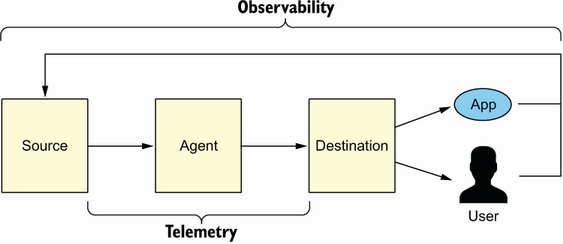
Use the observability overview to follow the flow from system sources through agents to destinations and feedback-driven action. section 1.1
The useful outcome is action, not merely displaying errors. A human may restart a service, while an application such as a cluster autoscaler may add worker nodes from measured utilization. Instrumentation, retention, agent overhead, and network transfer impose costs, so investment should follow explicit goals. section 1.1 section 1.5.1















