liveBook · Manning

Probability theory

As explained in Learn AI-Assisted Python Programming, Second Edition

Probability is a numerical measure of the likelihood that an event will occur.

Probability measures how likely an event is. In games, it helps compare risky choices with the possible reward. section 10.4.1

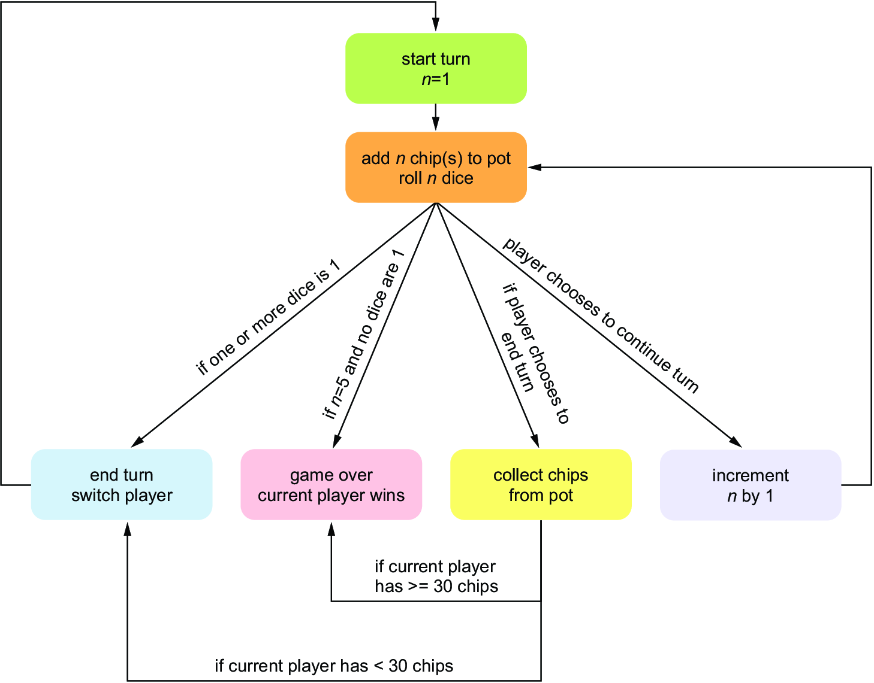
In Bogart, continuing a turn increases both the pot and the chance of losing it:

  • One die gives a 1-in-6 chance of rolling a 1, or about 17%. section 10.4.1
  • The chance of rolling at least one 1 rises to about 31% with two dice, 42% with three, 52% with four, and 60% with five. section 10.4.1
  • A player must balance pressing their luck for more chips against stopping before the probability of losing becomes too high. section 10.4.1

Random values in Python

The random module can generate an integer with random.randint(1, 6), representing a die roll, or a fractional value with random.random(). A float between 0 and 1 can represent how likely an event is, with larger values indicating higher probability. section 10.2

Figure 10.5 Player turn in Bogart
figure

Trace the player-turn sequence in Bogart, including escalating dice rolls, risk, and stopping decisions. section 10.4.1


How Learn AI-Assisted Python Programming, Second Edition covers it

How deep it goes
Develops game-based intuition and basic random-number usage, stopping short of formal probability theory.
Examples
Uses Bogart dice rolls, escalating chances of rolling a 1, and Python random-number outputs.
What it assumes
Builds from zero with dice and game decisions rather than assuming mathematical or programming knowledge.
What you can do after
Apply it via Python’s random module to generate dice-like integers and probability-like floating-point values.
How it connects
Connects probability to randomness, random numbers, dice, and game strategy.

Also explained in

Compare how 16 books explain probability theory →

Related concepts

This explainer was generated by Manning's knowledge graph from the text of Learn AI-Assisted Python Programming, Second Edition. The section links point to the parts of the book it draws on.













