Probability assigns each possible measurement outcome a number from zero to one. For a qubit in α|0⟩ + β|1⟩ with real amplitudes, outcomes 0 and 1 occur with probabilities α² and β². section 4.1.1
For a multiqubit state a₀|00⟩ + a₁|10⟩ + a₂|01⟩ + a₃|11⟩, each computational-basis outcome has probability equal to the square of its corresponding amplitude. A basis state therefore produces its matching result with probability one. section 4.1.1
Quantum algorithms use measurement probabilities to:
- Read one of the basis states with nonzero amplitude when a system is in superposition. section 4.9
- Prepare a state whose measurement produces a problem solution with high probability. section 4.9
- Estimate outcome distributions across repeated trials rather than obtaining complete state information from one measurement. section 4.9
Figure 4.2 Measuring two qubits in a superposition of all basis states can give any of the results 00, 01, 10, and 11, with probabilities equal to squares of the amplitudes of the corresponding basis states in the superposition state. When we measure a system that is in a specific basis state, we can only get the result that corresponds to that state, with 100% probability.
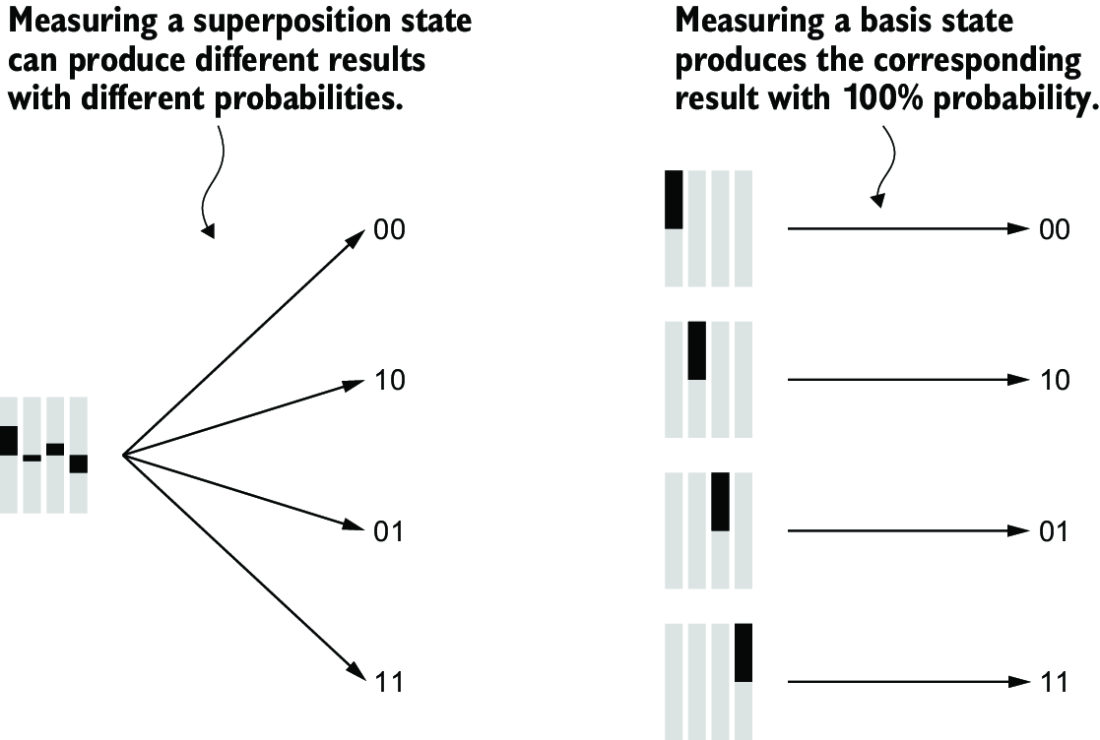
Compare the four possible outcomes of measuring a two-qubit superposition and the squared amplitudes that determine their probabilities. section 4.1.1















