An objective function, also called a loss or cost function, measures the error between a model’s predictions and actual outcomes. During fine-tuning, training optimizes the model’s weights and parameters to minimize this error. section 9.3.4 section 9.2.1
Use loss metrics to monitor learning and distinguish improvement from poor generalization:
- Training loss measures errors on training examples; lower values indicate predictions closer to the observed data. section 9.3.4
- Validation loss measures errors on held-out examples, usually after each epoch, using the same cost function as training loss. section 9.3.4
- Compare both curves: declining training and validation loss suggests learning, while fitting training data too closely can harm generalization. section 9.3.4
Reading a fine-tuning loss curve
A fine-tuning run reports loss for each training step, where each step processes a batch of examples. If loss decreases as the steps advance but does not reach zero, the model is improving while still making errors; this is normal and may support better performance on unseen data than perfect training fit. section 9.3.4
Figure 9.3 Training loss when fine-tuning GPT-3.5 Turbo
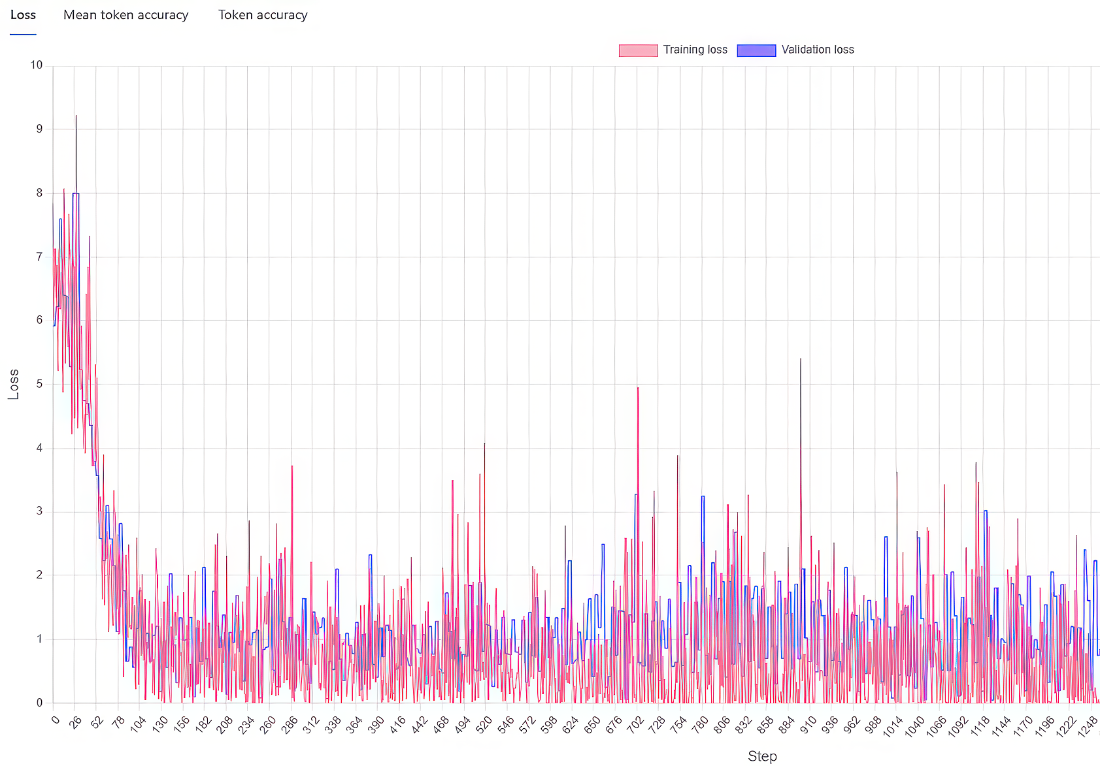
Inspect the training-loss curve for GPT-3.5 Turbo fine-tuning to connect the metric with step-by-step model improvement. section 9.3.4





























