During LLM training, the objective function turns each batch’s prediction quality into a loss signal used to adjust the model’s weights. Repeating prediction and adjustment across epochs improves the model, while monitoring loss helps detect overfitting to training data. section 5.2.1
A practical training loop uses the objective function to:
- Process tokenized data in batches, obtain predictions, calculate loss, and apply backpropagation. section 5.5
- Track training behavior alongside techniques such as early stopping, dropout, and learning-rate scheduling; none alone guarantees generalization. section 5.2.1
- Optimize for broad text understanding rather than merely minimizing loss on the training data. section 5.2.1
Figure 5.2 A simplified version of all the steps necessary to train a language model (large or otherwise) from scratch. You must have data, then define all of the model behavior, and only then proceed to train.
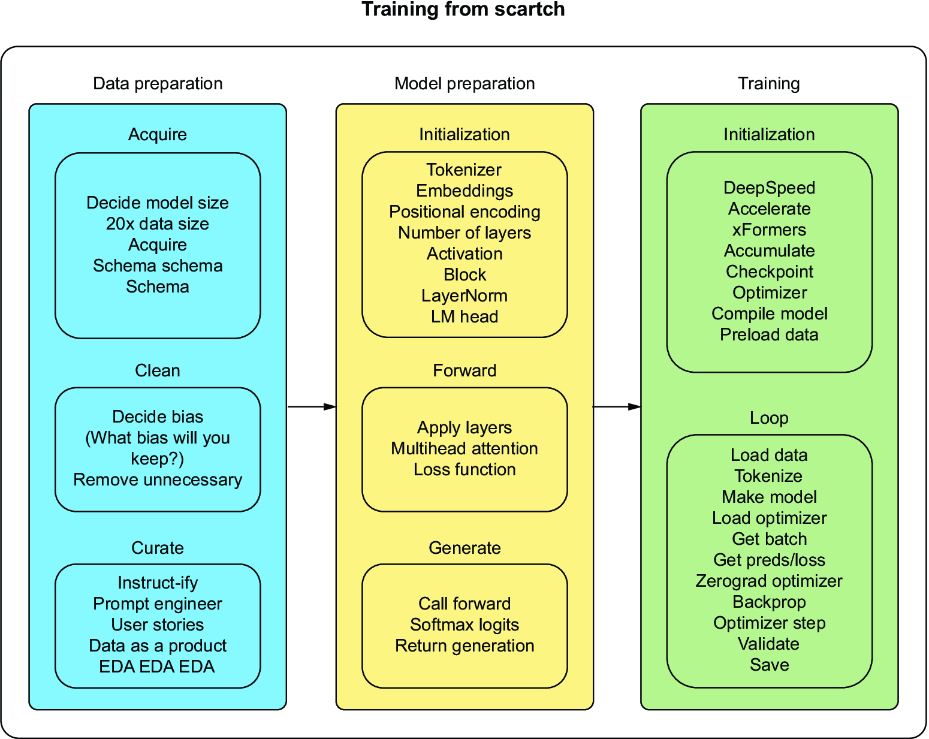
Use the training-pipeline figure to place the objective function after data preparation and model definition, before iterative training. section 5.2.1





























