A high-risk drug classifier can look accurate while missing cases that matter. Recall, also called sensitivity, measures the proportion of actual positive cases the classifier identifies: true positives divided by true positives plus false negatives. For a high-risk class, it answers: how many drugs labeled high risk did the model find? section 4.6.5
Recall does not say how often a high-risk prediction is correct; precision answers that question. Lowering the classification threshold generally catches more positives, but can also raise false alarms. Raising it can miss real positives. Choose the tradeoff for the task rather than treating the default 0.5 threshold as automatically optimal. section 4.6.5 section 4.7
Tuning a high-risk classifier
A drug classifier uses descriptions and side effects as inputs and derives high-risk labels from interaction keywords. Plot precision and recall against the threshold, then test the apparent tradeoff: in one run, the plot suggested a threshold just below 0.6, and an F1-based balance selected 0.5999. That balance is not necessarily the right choice when missing a high-risk case is costlier than a false alarm. section 4.6.3 section 4.6.5
Check what the labels and data actually represent before interpreting recall. The high-risk labels here come from keywords, and only 7,488 records have the fields used for classification, despite the much larger source dataset. Run generated code and inspect the results rather than trusting a metric or an AI recommendation alone. section 4.6.3 section 4.6.5
Figure 4.11 Precision vs. Recall at Different Thresholds.
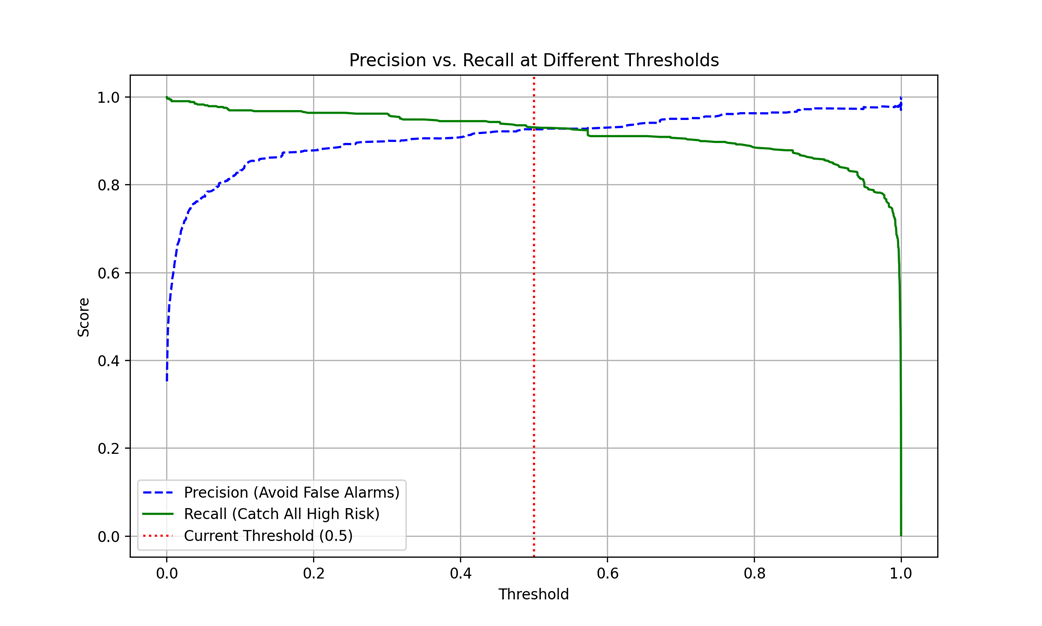
Use the threshold plot to inspect where recall changes and compare that change with precision before selecting a cutoff. section 4.6.5