When a classifier flags someone as sick, how do you balance catching more true cases against wrongly flagging healthy people? A receiver operating characteristic (ROC) curve tracks sensitivity and specificity as the decision threshold changes. section 7.3
Sensitivity is the share of positive cases correctly identified; specificity is the share of negative cases correctly identified. Raising the threshold lowers sensitivity and raises specificity, so each point on the curve represents a different balance. section 7.3
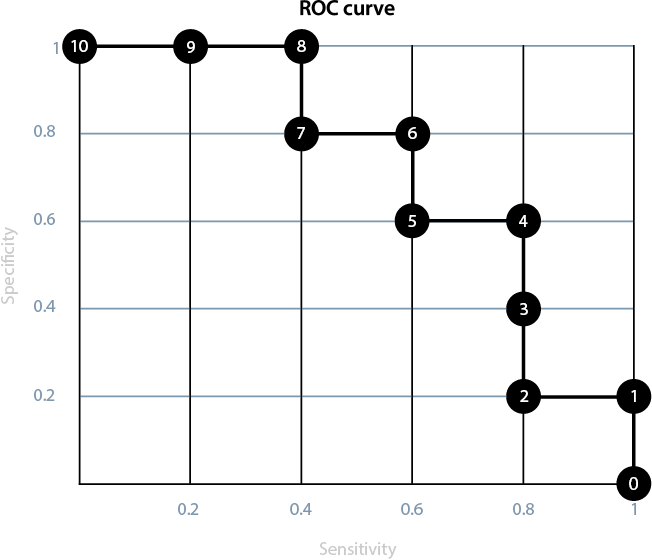
Figure 7.4 Here we can see the ROC curve corresponding to our ongoing example, which gives us a great deal of information on our model. The highlighted dots correspond to the timesteps obtained by moving our threshold from 0 to 1, and each dot is labeled by the timestep. On the horizontal axis we record the sensitivity of the model at each timestep, and on the vertical axis we record the specificity.
See how threshold steps become points on an ROC curve. section 7.3
The area under the curve (AUC) summarizes model performance: values closer to 1 indicate a better model, while values closer to 0.5 indicate a worse one. The curve also helps choose a threshold that suits the relative importance of sensitivity and specificity. section 7.4
Compare threshold choices
For a health test or spam filter, move the threshold through several values and record true positives and true negatives at each step. Compare the resulting sensitivity and specificity to choose a useful balance. section 7.3






