A recommender system is the infrastructure that selects and ranks items from a catalog for a user or context. Unlike an alphabetical listing, its choice and ordering are intentional: they may reflect preferences, current circumstances, or other users’ behavior. A storefront can show personalized “Recommended for you” items alongside non-personalized “Popular Products”; both are recommendations. section 1.2
The available data shapes the approach:
- Content metadata, such as tags or descriptions, supports recommendations based on item features. section 1.3 section 1.6
- Behavioral data, such as clicks, purchases, or ratings, supports collaborative filtering across users’ interactions. section 1.3 section 1.3.2
- Contextual data, such as time, device, or location, helps adapt results to the current situation. section 1.6
Recommendations can be user-to-item, based on a person’s profile or history, or item-to-item, based on related items. Production systems often combine methods rather than rely on one model. Because scoring millions of items with an expensive model is impractical, a multi-stage pipeline narrows the pool before applying more costly scoring and final ranking. section 1.6 section 1.4
A small movie pipeline
For a user with viewing history, retrieve movies similar to recently watched titles, remove those already watched, score the remaining candidates using similarity and popularity, then rank by a weighted score. If the user has no history, return popular movies instead. section 2.2.6
Figure 1.6 The recommender system feedback loop. Users receive recommendations, interact with content (clicks, purchases, views), interactions are logged, this data trains models, and improved models generate better recommendations.
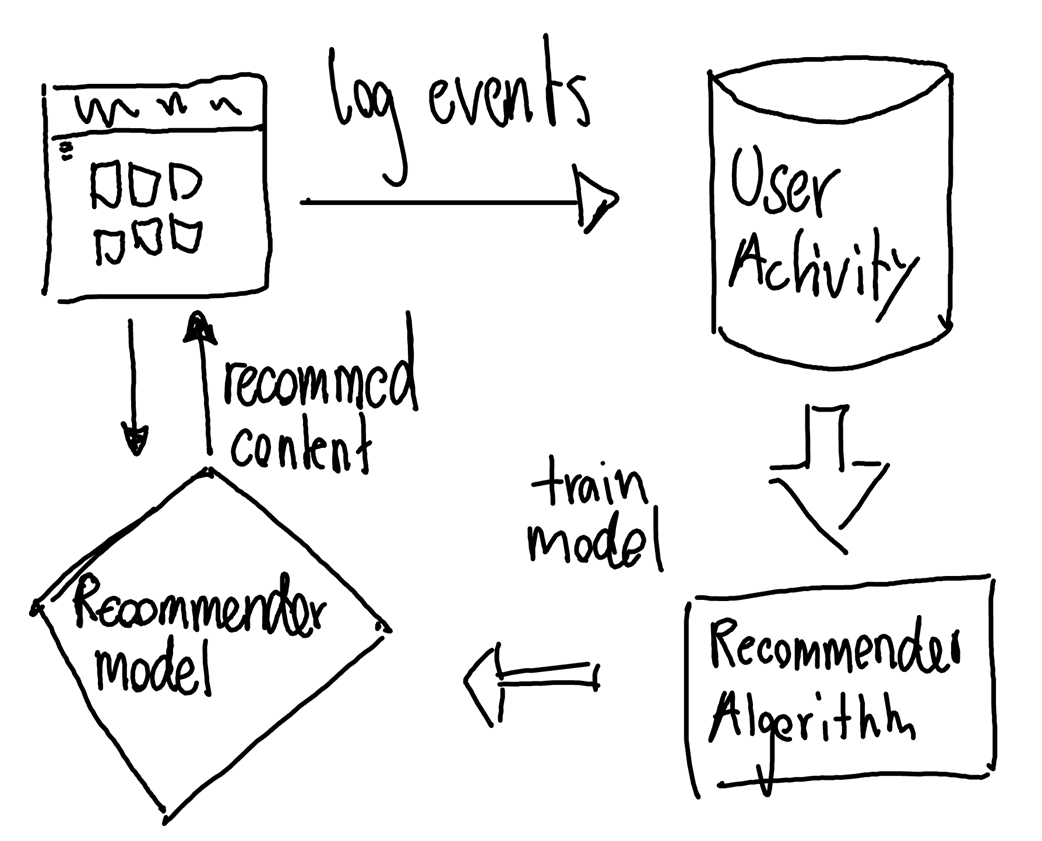
The feedback-loop diagram shows how recommendations lead to interactions that are logged and used for future recommendations. section 1.3
The loop creates trade-offs. Clicks are plentiful but do not necessarily mean satisfaction; explicit ratings are clearer but sparse. New users or items may lack interaction history, while repeated exposure can amplify popularity bias or narrow what users see. Evaluate the online experience as well as prediction accuracy, and avoid train–test splits that let later interactions predict earlier ones. section 1.3 section 1.6 section 1.1










