Choosing a film from a large streaming catalog can mean scrolling past hundreds of titles that do not interest you. A recommender system helps by selecting and ordering items according to a goal, such as predicted relevance to a user. Recommendations can be personalized from past behavior, though algorithmic ranking can also use criteria such as recency. section 1.1.1 section 1.1.2
A user is the person receiving recommendations; an item might be a film, product, post, or another piece of content. Unlike search, which starts with an explicit query, recommendations often respond to an implicit request: “Show me something relevant now.” section 2.1 section 1.1
Recommendations typically pass through several connected stages:
- Candidate generation narrows the available pool to a manageable set; filtering removes items such as blocked content. section 2.2
- Heavy ranking orders the remaining items by a predicted score, often based on engagement. Optional post-processing can adjust the order before delivery. section 2.2 section 2.8
- The platform delivers the results and records interactions, which help inform later recommendations. section 2.2
Figure 2.1 A bird’s-eye overview of a recommender system. Recommendations are not the output of a single operation; rather, they are the results of multiple interlinked operations. Candidates are generated from the universe of all possible content—for example, by picking posts from users that are followed. Later, candidates are filtered to restrict the pool to a more manageable number. At this stage, the content gets actively sorted by the Heavy Ranker in accordance with a predefined metric. Such a ranked list can be adjusted, if needed, before being delivered to the users, whose engagement is recorded. Platform policies influence the filtering and post-processing steps, for example, by limiting the amount of content from the same author.
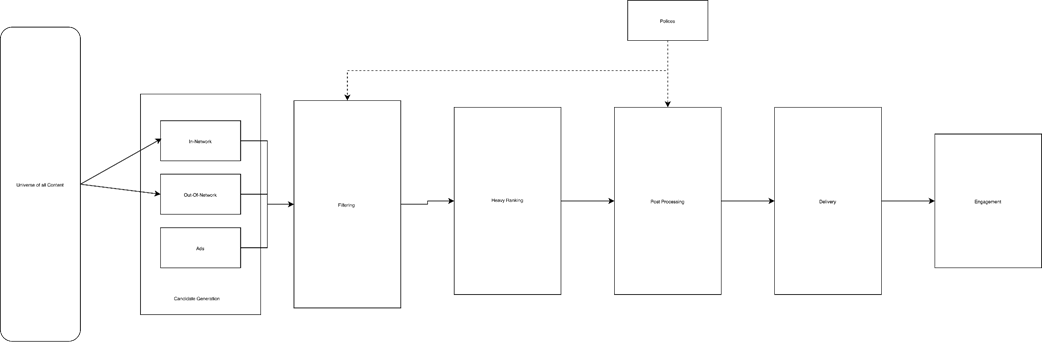
The pipeline shows how selection, ranking, platform policies, and user feedback work together. section 2.2
Ranking likes and replies
A social platform might predict both the chance of a like and the chance of a reply for each post. It combines those scores using weights: giving replies more weight can change which post appears first. The choice of weights is therefore also a choice about which behavior to prioritize. section 2.2.3
Learning from behavior creates a feedback loop. A system may show more from an account a person interacts with, but that interaction can itself depend on what the system chose to show. The system must balance showing familiar content with exploring other possible interests; it may never discover preferences it has not tested. section 1.2.2 section 4.2
Figure 1.1 The feedback loop between user and recommender systems. Users and recommender systems are in a mutual feedback loop, with the output of one serving as the input to the other. The output of the algorithm, the recommendations, is the input for the users. The users’ output, what they engage with, is a signal for the recommender. On top of that, both the user and the recommender system update their internal state. Users change their minds and evolve their preferences over time, while algorithms learn users’ preferences and try to align more with them.
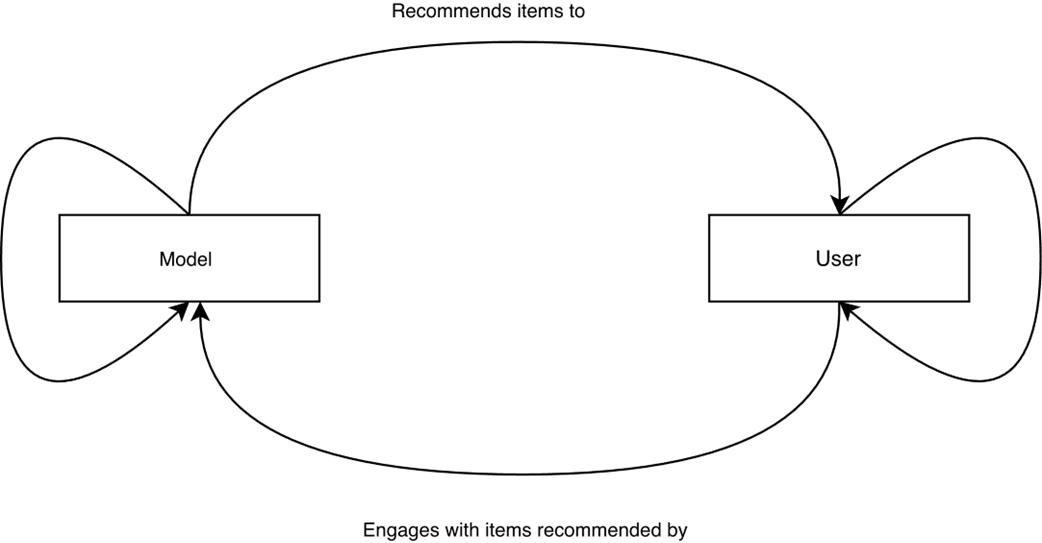
The feedback loop shows how recommendations and user behavior influence each other over time. section 1.0
Ranking distributes attention as well as saving time. If a travel platform places chain hotels above independent ones, the latter may receive fewer customers. On social media, recommendations can also amplify content beyond a user’s immediate connections; autoplay and endless feeds can make those choices less deliberate. section 1.1 section 1.2.2 section 1.3.2
Evaluating a recommender is difficult because value is personal and cannot be directly measured across every possible item. Engagement is a practical signal, but a clickbait headline can attract clicks without being valuable. Popularity can also reinforce itself when prominently displayed items attract still more attention. section 1.3.3 section 4.0