Improves an LLM’s reasoning during training by rewarding responses that produce desirable outcomes. It is usually a post-training stage after pretraining and sometimes instruction fine-tuning, although reasoning-focused RL can also start from a pretrained base model. section 1.3 section 6.1
A practical RL workflow for reasoning models includes:
- Frame reasoning as sequences of actions and outcomes rather than explicit rule execution. section 1.5
- Sample multiple responses for each prompt and compute group-relative learning signals from their rewards. section 6.0
- Use task-correctness rewards in reinforcement learning with verifiable rewards (RLVR), or human feedback in RLHF. section 6.0
- Update model weights with group-based policy optimization to reinforce higher-reward reasoning behavior. section 6.0
RL differs from inference-time scaling: RL invests computation during training to improve later accuracy, while inference-time scaling spends more computation per generated answer. The two approaches can be combined. section 6.1
Figure 6.4 Road map of this chapter. After this section’s brief introduction to RL for LLMs, we’ll discuss the difference between two RL stages, RLHF and RLVR. In the rest of the chapter, we’ll focus on implementing RLVR using the GRPO algorithm.
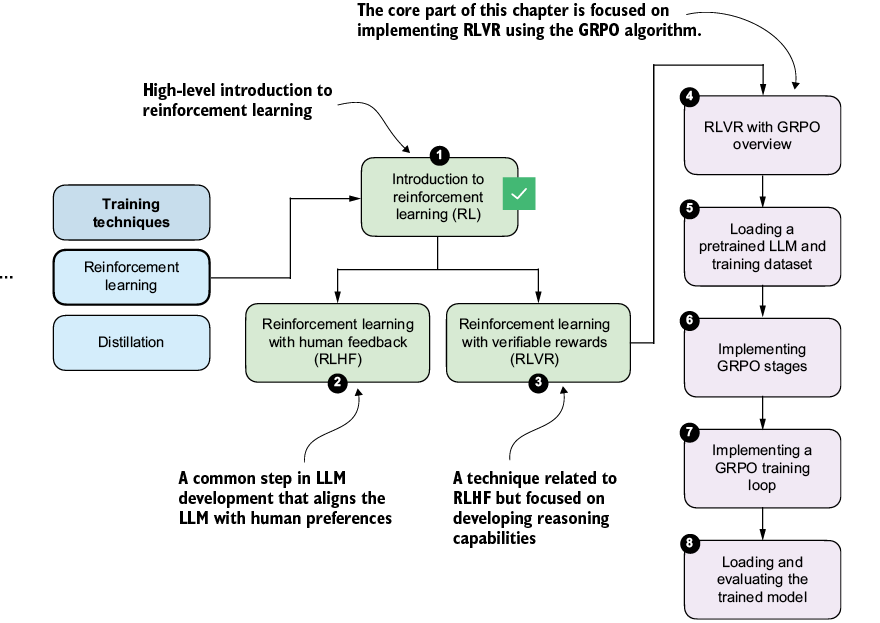
Use the roadmap to place RL after the introductory distinction between RLHF and RLVR and before implementation with GRPO. section 6.1

















