Reinforcement learning is a machine-learning approach in which a system improves behavior through sequential interactions, trial and error, and reward signals. Positive outcomes encourage actions, while penalties prompt correction. section 1.5.4
The learning loop consists of:
- Taking an action in an ongoing sequence of interactions. section 1.5.4
- Receiving a positive or negative reward signal. section 1.5.4
- Correcting and improving later behavior iteratively. section 1.5.4
Chess and autonomous navigation
In a chess example, a computer first loses after several moves, then improves across repeated rounds until it wins. Self-driving cars provide another application: reinforcement learning helps determine when to turn, move, or stop. section 1.5.4 section 1.7
Figure 1.10 ML algorithms can be classified as supervised learning algorithms, unsupervised learning algorithms, semisupervised learning algorithms, and reinforcement learning algorithms.
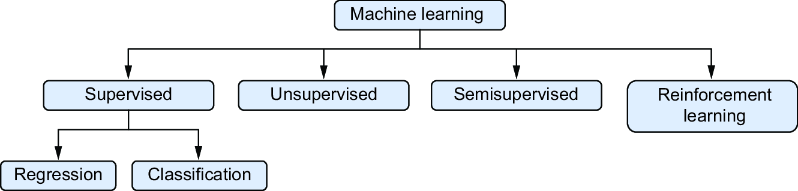
Use the classification figure to compare reinforcement learning with supervised, unsupervised, and semisupervised learning. section 1.5

















