liveBook · Manning

Reinforcement learning

As explained in Grokking Machine Learning

A machine-learning approach in which an agent learns to choose actions by interacting with an environment and receiving rewards or punishments.

Reinforcement learning trains an agent to pursue a goal by interacting with an environment. Rewards and punishments guide its decisions instead of labeled training data. section 2.4

Robot in a grid world

A robot seeks treasure, avoids a dragon, and cannot pass through a mountain. Reaching treasure earns 100 points, meeting the dragon loses 50, and each step costs 1 point. By exploring and remembering scores, the robot learns which squares are promising and can choose a route to the goal. section 2.4

Figure 2.11 A grid world in which our agent is a robot. The goal of the robot is to find the treasure chest, while avoiding the dragon. The mountain represents a place through which the robot can’t pass.
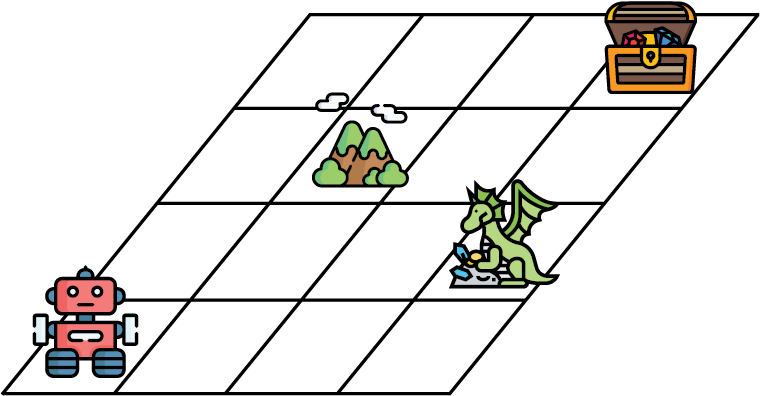
The grid-world figure shows the robot’s goal, hazard, and blocked square. section 2.4


How Grokking Machine Learning covers it

How deep it goes
Defines agents, environments, goals, and rewards, then sketches learning from scores; it stops short of further detail.
Examples
Uses a grid-world robot that seeks treasure, avoids a dragon, cannot cross a mountain, and loses points for each step.
What you can do after
Understand how an agent can use accumulated scores to choose a path toward a goal and away from hazards.
How it connects
Connects agents, environments, goals, rewards, and punishments with machine learning.

Also explained in

Compare how 18 books explain reinforcement learning →

Related concepts

This explainer was generated by Manning's knowledge graph from the text of Grokking Machine Learning. The section links point to the parts of the book it draws on.















