Reinforcement learning from human feedback (RLHF) steers a language model by having people judge responses as acceptable, problematic, or preferable. Those judgments estimate a reward function, which then guides the model toward responses that human evaluators rate more favorably. Because evaluators can disagree, the resulting reward approximates rather than perfectly defines ideal behavior. section 2.10
RLHF is useful but not cost-free:
- It can produce more robust behavioral changes than supervised fine-tuning, while requiring additional data to train a reward model. section 2.11 section 3.8
- Direct preference optimization (DPO) trains directly on human preference pairs, avoiding the intermediate reward model and often reducing complexity and computation. section 2.11
- RLHF can accommodate varied feedback and complex reward functions, whereas the original DPO formulation relies on binary comparisons between two responses. section 2.11
Safety post-training
Providers use RLHF among other post-training methods to steer responses away from harms such as privacy violations and dangerous misinformation. This work can expose outsourced annotators to traumatic material, while disagreement about what counts as safe makes the target behavior contested rather than purely technical. section 3.8
Figure 2.7 A typical setup for reinforcement learning from human feedback, after a supervised fine-tuning step for dialogue
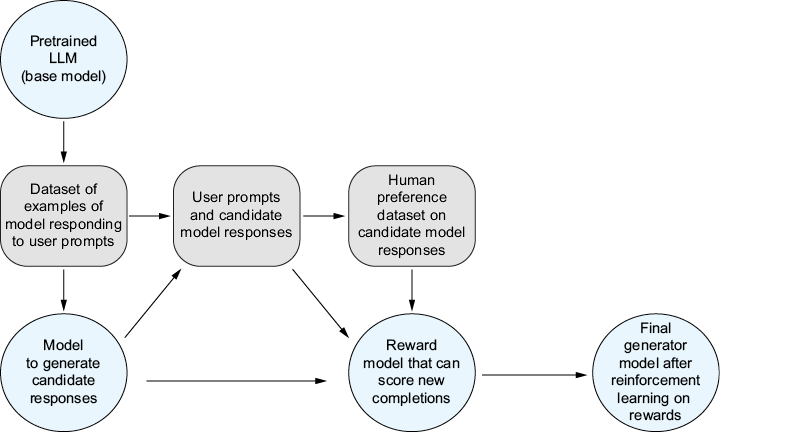
Shows a typical RLHF arrangement for dialogue after supervised fine-tuning, clarifying how human feedback enters the training process. section 2.10













