A legal agent researching a contract dispute may retrieve both an original agreement and a later amendment. Retrieval-augmented generation (RAG) supplies relevant external information to a model as context, but finding a document does not establish whether it governs the dispute. section 1.2.3 section 5.4
Enterprise RAG governs how candidate knowledge enters an agent’s working view. It connects the model to enterprise data, but access alone does not establish institutional meaning or permission to rely on a source. section 5.0 section 5.4 section 5.4.1
A permitted decision context depends on complementary controls:
- Enterprise RAG brings candidate information through governed retrieval routes. section 5.4.1
- An Enterprise Knowledge Graph preserves governed concepts and relationships for interpreting that information. section 5.4
- Trusted Context determines what the agent may rely on for the current matter, purpose, and authority level. section 5.0 section 5.4.1
Figure 5.5 How Enterprise RAG, the Enterprise Knowledge Graph, and Trusted Context work together
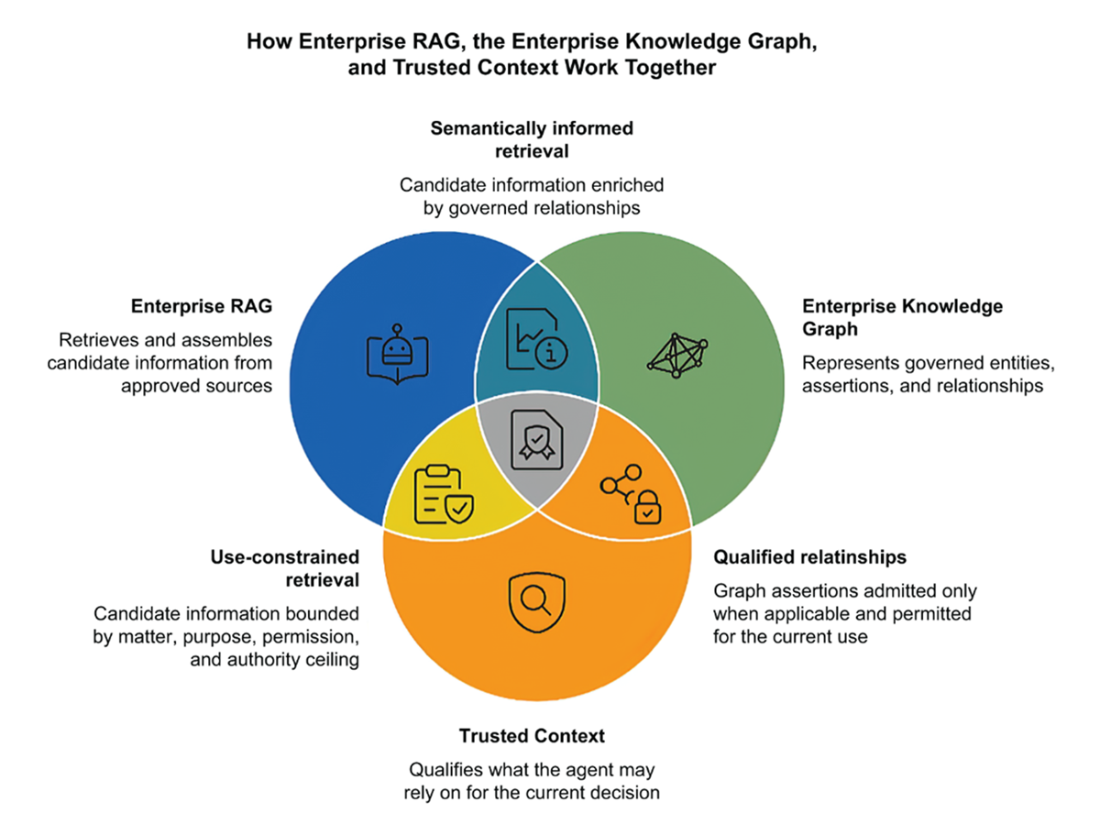
Compare how retrieval, governed meaning, and Trusted Context contribute to a permitted decision context. section 5.4.1
Relevance is not authority
A query may rank an original agreement above a governing amendment because its wording matches more closely. It may also rank a judgment from another jurisdiction above the controlling authority. Both results can be genuine and accurately quoted yet lead to an unsound position. Preserve version, effective period, jurisdiction, source status, matter, purpose, and evidential standing alongside retrieval results. If the governing source cannot be established, qualify the position, seek further evidence, or reduce the agent’s authority. section 5.7.3