Return on investment (ROI) compares an initiative’s gain or loss with the investment required to produce it. Traditional ROI works best for deterministic automation: estimate the work volume, calculate labor savings, and project a payback period. section 3.0
Agentic systems weaken those assumptions because behavior is uncertain, governance continues after implementation, and value may emerge along a nonlinear path. A single ROI estimate can therefore make an autonomy initiative look attractive while overlooking persistent governance costs, probabilistic failure, and delayed benefits. section 3.0 section 3.1
Use ROI cautiously when evaluating delegated autonomy:
- Estimate direct investment and expected benefits, but include the continuing cost of governance. section 3.0
- Treat failure as probabilistic and allow risk to reshape both cost and benefit over time. section 3.1
- Read early negative results as evidence about the initiative’s trajectory rather than as an automatic cancellation signal. section 3.1
Claims-triage pilot
A traditional ROI lens records the pilot’s deeply negative result at month six and may recommend cancellation. A trajectory-based assessment asks whether the initiative is on a credible path to profitability, recognizing that learning and governance maturation can precede later value. section 3.1
Figure 3.2 Cost, benefit, and risk do not combine additively in agentic systems. Each input shapes Net Agentic Value, and risk continuously reshapes both cost and benefit over time. NAV therefore emerges as a trajectory, not a fixed output. Figure 3.2 traces this trajectory through the economic lifecycle.
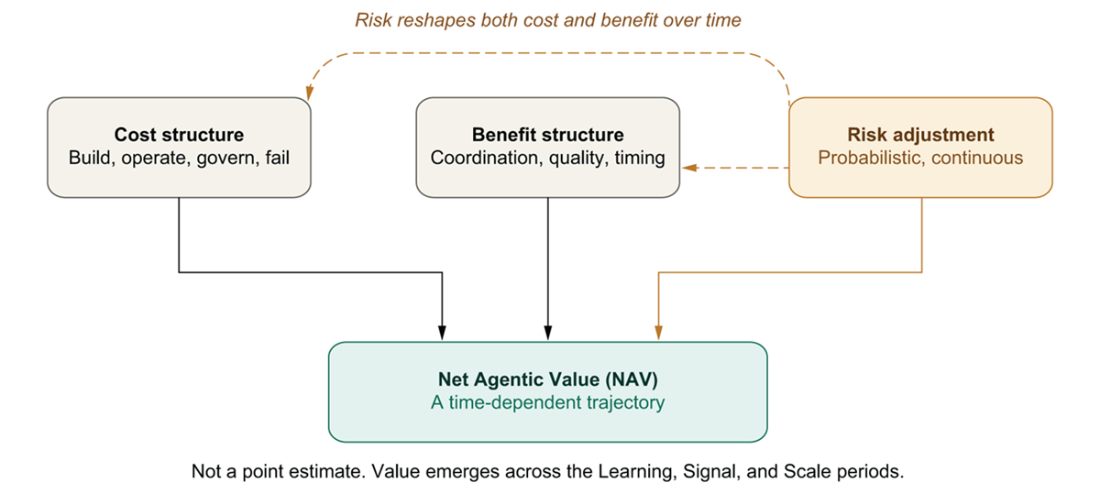
Shows how cost, benefit, and risk combine into a time-dependent economic trajectory rather than a fixed ROI output. section 3.1













