Sentiment analysis measures the emotional content of words, phrases, or larger text and turns opinions into signals such as positivity, negativity, or another emotional quality. It helps organizations handle feedback at a scale where manual reading becomes tedious and error-prone. section 2.6
Common uses include:
- Summarizing large volumes of customer reviews and open-ended product feedback. section 2.6
- Producing numerical ratings that represent positive, negative, or other emotional qualities in text. section 2.6
- Filtering junk mail and troll messages so conversational systems can respond appropriately. section 2.6
- Serving as a foundational natural-language-understanding application alongside search and conversational AI. section 1.3
From review text to a useful signal
A company can replace some manual review of thousands of customer comments with an NLP pipeline that processes each comment and assigns an emotional rating. Unlike a star-rating field, an empty comment box can capture more detailed reactions, while automated processing makes the volume manageable. The result still requires care: NLP algorithms make mistakes and can be biased. section 2.6 section 1.3
Figure 1.3 Graph of NLP applications
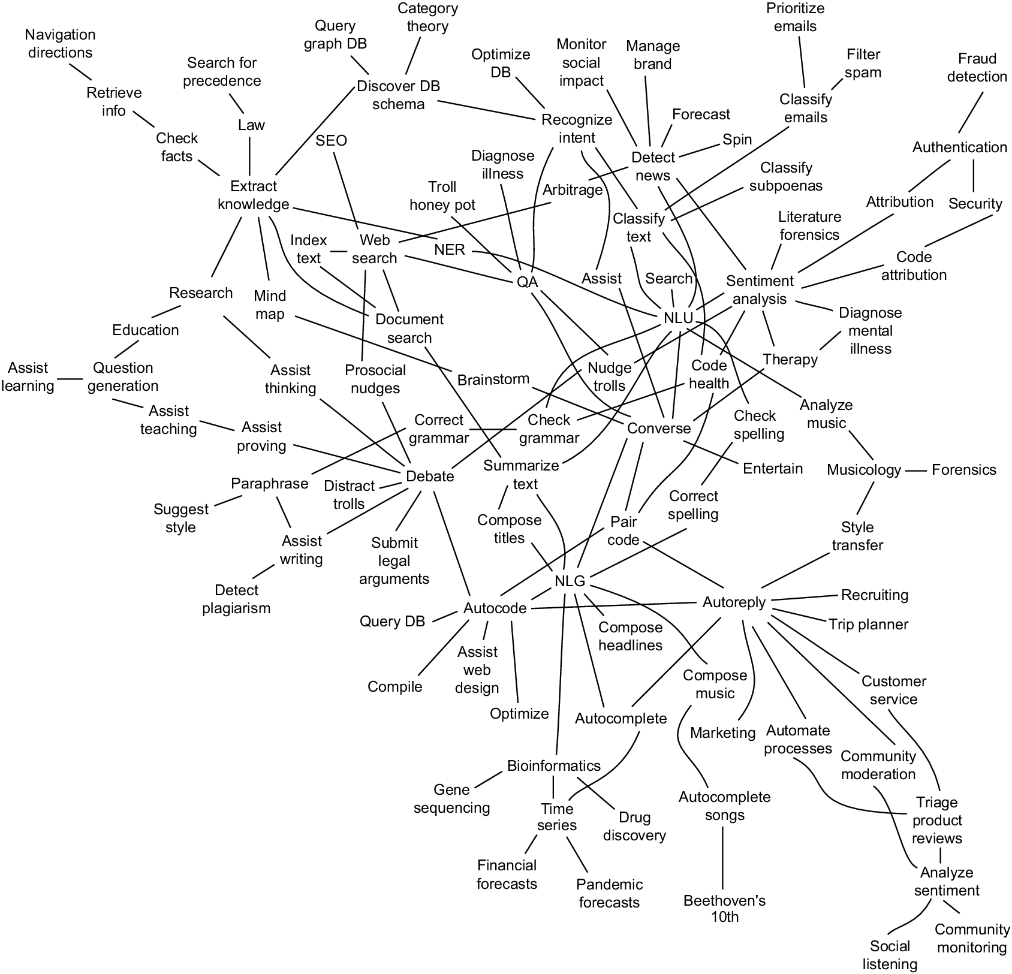
Use the NLP application graph to place sentiment analysis among natural-language-understanding applications and its connections to search, generation, and conversational systems. section 1.3











