A sigmoid is a smooth S-shaped activation function that squashes real-valued inputs into a bounded range, commonly between zero and one. This makes it useful when a neural network must produce a binary-classification probability, although its gradients become close to zero at extreme inputs. section 4.1.1
Use sigmoid to:
- Turn a weighted sum into a probability in a single-layer neural network equivalent to logistic regression. section 4.1.2
- Produce a same-person prediction from cosine similarity between face embeddings in a Siamese network. section 7.2.2
- Choose between activation functions with practical trade-offs: sigmoid supports bounded outputs, while ReLU avoids its extreme-input gradient problem and often converges faster. section 4.1.1
Face matching
Two copies of a CNN generate embeddings for a pair of face images. Cosine similarity passes through a sigmoid to yield a value from zero to one, which is compared with a label using binary cross-entropy. section 7.2.2
Figure 4.5 Some examples of activation functions commonly used in deep neural networks – Sigmoid, TanH, and ReLU.
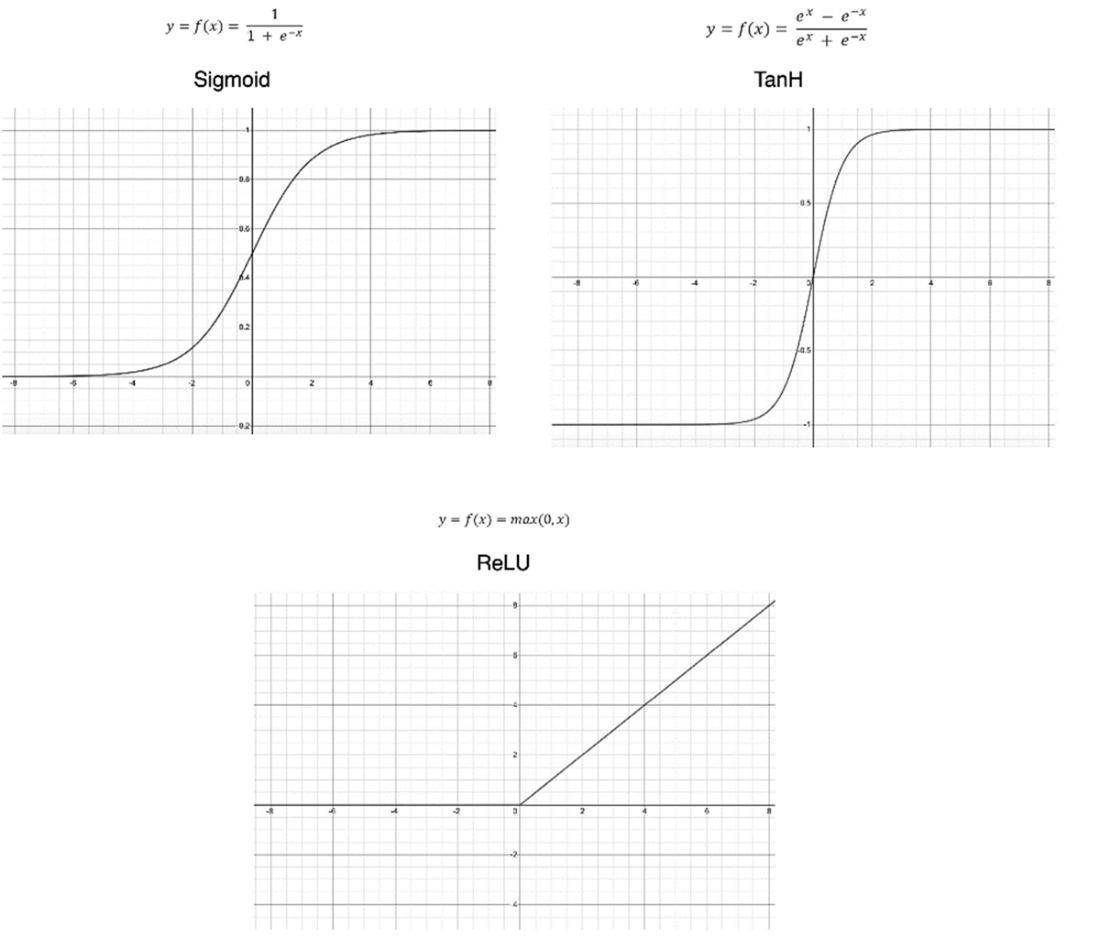
Compare sigmoid with TanH and ReLU as commonly used deep-learning activation functions. section 4.1.1
Figure 7.12 Demonstration of how a face recognition model is trained using the Siamese network. Two copies of a CNN model produce two different embeddings for two different faces (images). These embeddings produce a cosine similarity score. This score is passed through a sigmoid function and compared to the label (1 if faces are from same person and vice versa) using a loss function such as binary cross entropy.
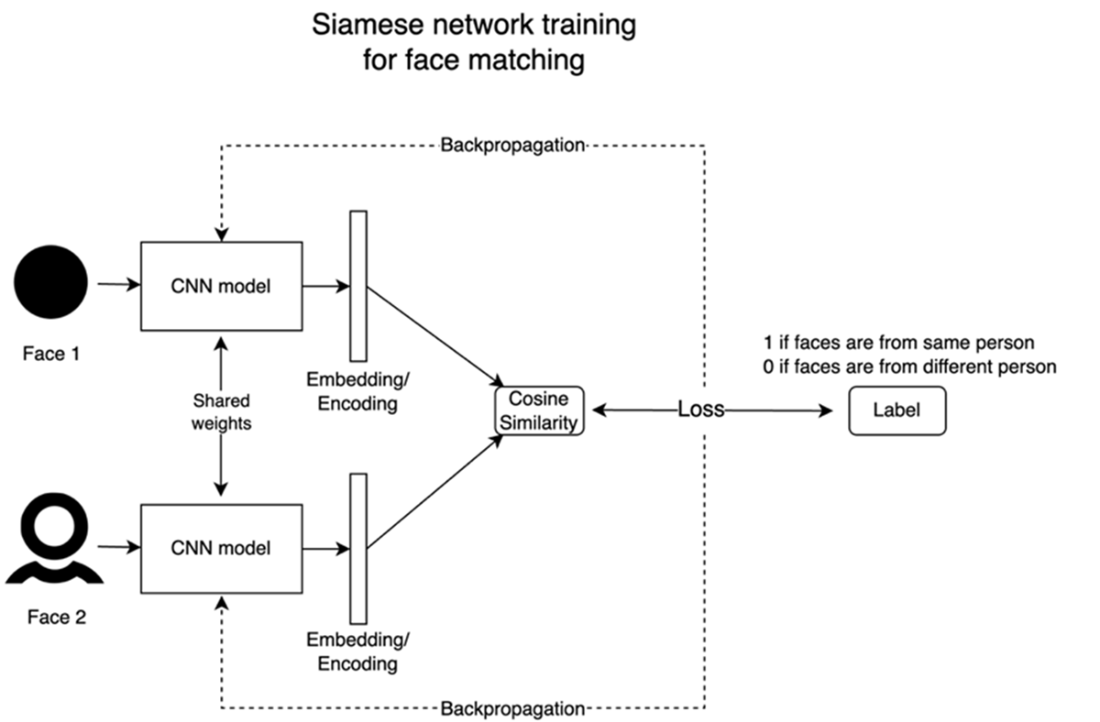
Trace sigmoid’s position in a Siamese face-recognition training pipeline. section 7.2.2






















