A sigmoid turns a score into a smooth number between 0 and 1. Positive scores move toward 1, negative scores move toward 0, and a score of 0 becomes 0.5. This makes a classifier express degrees of confidence instead of only yes-or-no decisions. section 6.2 section 6.0
Figure 6.2 The sigmoid function sends the entire number line to the interval (0,1).
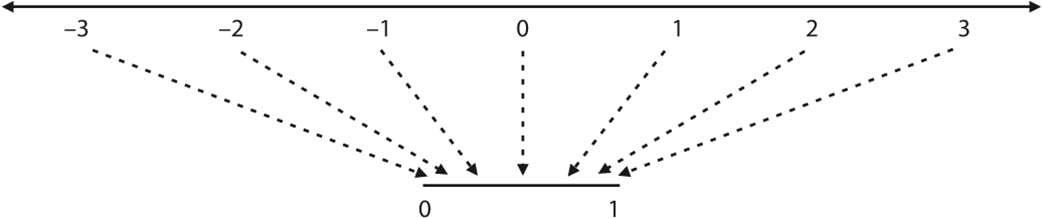
The curve squeezes the whole number line into the interval between 0 and 1. section 6.2
For a logistic classifier, use the sigmoid in three small steps:
- Compute a score by multiplying each feature by its weight, adding the results, and adding a bias. section 6.11
- Apply the sigmoid: σ(x) = exp(x) / (1 + exp(x)). The result is the prediction. section 6.11
- Interpret predictions above or equal to 0.5 as one class and lower predictions as the other when using that threshold. section 6.3
Scoring an alien-language sentence
With weights 1 for “aack,” 2 for “beep,” and bias −4, a sentence containing three aacks and two beeps gets score 3 + 2×2 − 4 = 3. Its sigmoid prediction is 0.953: close to the happy end, even though the label can still reveal a mistake. section 6.3
Sigmoid replaces the discontinuous step function in a continuous perceptron. Its continuous, differentiable shape supplies richer predictions and supports the calculus used while training. In neural networks, it can serve as an activation function, especially at an output layer; its flat derivatives can also contribute to vanishing gradients. section 6.2 section 10.25
def sigmoid(x):
    return np.exp(x)/(1+np.exp(x))
This compact NumPy implementation converts one numeric score into a sigmoid prediction. section 6.11