A feature is a measurable property or encoded attribute of a data point that a machine-learning model uses as input to learn a relationship with a label. In drug discovery, features can represent molecular structure or chemical properties. section 3.0 section 1.3.2
Molecular features can be hand-crafted or learned, and may include:
- Simple measurements, such as molecular weight or counts of atoms and bonds. section 1.3.2
- Molecular descriptors and encoded substructures, including structural-key bits that indicate whether a molecule contains predefined features. section 2.4.1 section 4.0
Featurization selects relevant attributes and transforms them into a format a model can use. Hand-crafted features represent patterns chosen by people; deep learning can instead learn task-specific features. A predefined structural-key dictionary cannot encode structures it does not include. section 3.0 section 1.3.2 section 2.4.1
Figure 2.11 Suppose we have a fragment library with 8 structural keys. Our bit string of length 8 initially has all positions set to “0”. The molecule on the left contains one structural feature that corresponds to the 7th bit, flipping it to “1.” The molecule on the right contains both the 7th bit’s structural feature and a structural feature encoded by the 4th bit.
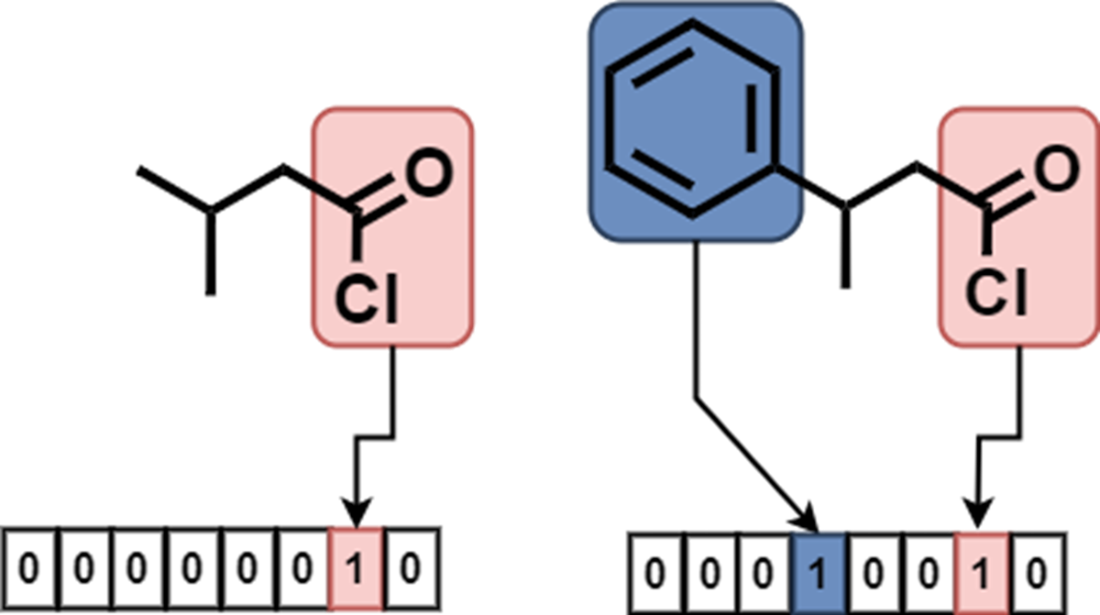
A bit-vector illustration shows how predefined structural features set corresponding bits to 1 when present in a molecule. section 2.4.1













