A signal is an analytical model’s output that conveys information for a financial decision or action. A market-direction prediction can inform a trading decision; a fraud alert can prompt investigation. Neither is a decision by itself: business goals, risk appetite, regulatory requirements, and policy determine how the output is used. section 1.4 section 1.4.3
Figure 1.3 Financial AI applications aren’t just trained models or UIs. They connect curated data assets, predictive or generative models, strategy and monitoring rules, and application workflows. Feedback from real-world outcomes flows back into the system, helping teams refine data, models, thresholds, and operational decisions over time.
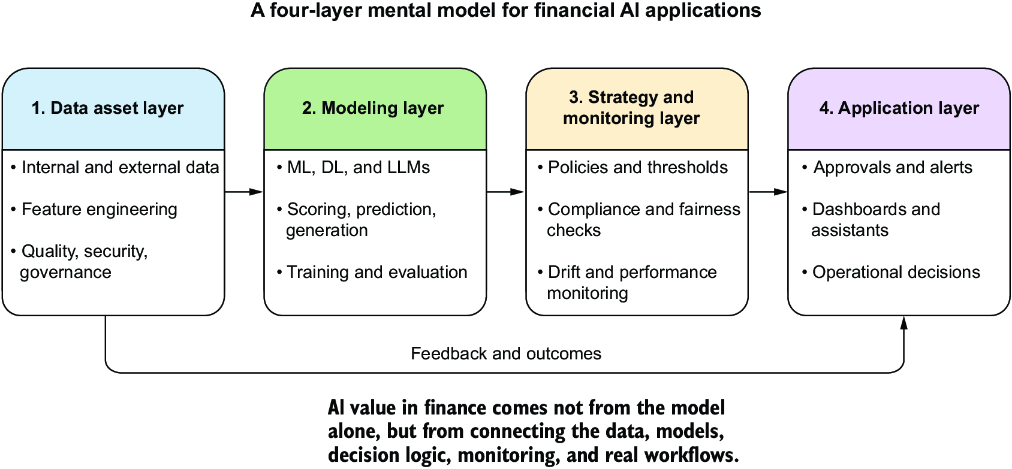
The four-layer workflow places signals between models and governed decisions, with outcome feedback informing later refinements. section 1.4
A practical signal workflow connects evidence to action:
- Prepare data and produce model outputs. Quantitative models can use price and volume features; a qualitative pipeline can retrieve news and extract structured assessments. section 11.0
- Translate outputs into decisions using strategy, thresholds, and policies. Evaluate them with metrics suited to the task, such as precision and recall for fraud or Sharpe ratios for portfolios. section 1.4.3
- Deliver decisions into workflows and monitor outcomes. Feedback can guide changes to data, models, thresholds, and operational decisions. section 1.4
A quantitative trading signal
A random forest produces up, down, or neutral market-direction predictions across time-series test folds. Its 52.2% directional accuracy applies only when both the prediction and actual movement are directional. This modest out-of-sample edge is not yet a trading return: transaction costs, slippage, and capital allocation constraints still need consideration. section 10.5.5
Listing 10.10 Trading-focused evaluation
from sklearn.metrics import classification_report

print("=== TRADING-FOCUSED EVALUATION ===")

# Calculate directional accuracy (Up/Down predictions only)
directional_accuracies = []
prediction_counts = {'up': 0, 'down': 0, 'neutral': 0}

for i in range(len(all_predictions)):
    pred, actual = all_predictions[i], all_actuals[i]

    # Count prediction types
    if pred == 1:
        prediction_counts['up'] += 1
    elif pred == -1:
        prediction_counts['down'] += 1
    else:
        prediction_counts['neutral'] += 1

# Focus on directional accuracy
directional_mask = [(p != 0 and a != 0) for p, a in zip(all_predictions, all_actuals)]    #1
directional_preds = [p for p, mask in zip(all_predictions, directional_mask) if mask]
directional_actuals = [a for a, mask in zip(all_actuals, directional_mask) if mask]

if len(directional_preds) > 0:
    directional_correct = sum(p == a for p, a in zip(directional_preds, directional_actuals))
    directional_accuracy = directional_correct / len(directional_preds)
else:
    directional_accuracy = 0

# Summary results
balanced_acc = balanced_accuracy_score(all_actuals, all_predictions)    #2

print(f"Balanced Accuracy: {balanced_acc:.1%}")
print(f"Directional Accuracy: {directional_accuracy:.1%}")
print(f"Prediction Distribution:")
print(f"  Up signals: {prediction_counts['up']}")
print(f"  Down signals: {prediction_counts['down']}")
print(f"  Neutral: {prediction_counts['neutral']}")
The evaluation listing shows how directional predictions are filtered before directional accuracy is calculated. section 10.5.5
A qualitative news signal
A retrieval-augmented news pipeline turns narrative analysis into a JSON dataset entry. One uranium-market assessment includes sentiment_score 65, supply_risk 7/10, policy_tone 6/10, key events, and reasoning. The scores are usable features; the reasoning provides an audit trail. Such qualitative signals can complement quantitative signals. section 11.4.3 section 11.0
Treat an LLM-generated signal as a hypothesis to verify, not proof of an edge. Retrieval grounding reduces temporal leakage but cannot eliminate information learned during pretraining. Evaluation, guardrails, and human oversight reduce risks without removing them. section 11.1.1 section 11.5