A signal is an observable piece of information, activity, behavior, or event indicating a change that may affect a session, outcome, or result. In collaborative work, signals reveal group dynamics, perspectives, relationships, and emerging problems. section 5.4.2
Strong signals are obvious and easy to observe; weak signals are harder to detect and may initially seem random. One occurrence does not establish a pattern, so facilitators connect repeated observations with other signals and information. section 5.4.2
Use signals to manage movement between opposing ways of working:
- Observe behavior without interpreting it, and consider a threshold when first learning to use a polarity map. section 10.2.2
- Treat signals as prompts to move between poles, pairing each observation with an action or heuristic. section 10.2.2
- When a group struggles to identify signals, ask which situations make the polarity feel consequential and what people observe happening. section 10.3.3
BigScreen
During a discussion about standard products versus customized solutions, a clear insistence on the standard-product approach is a strong signal of dissatisfaction. A joke about joining another team’s Friday drinks may be a weak signal of disagreement or possible departure; it becomes meaningful when connected with other observations. section 5.4.2
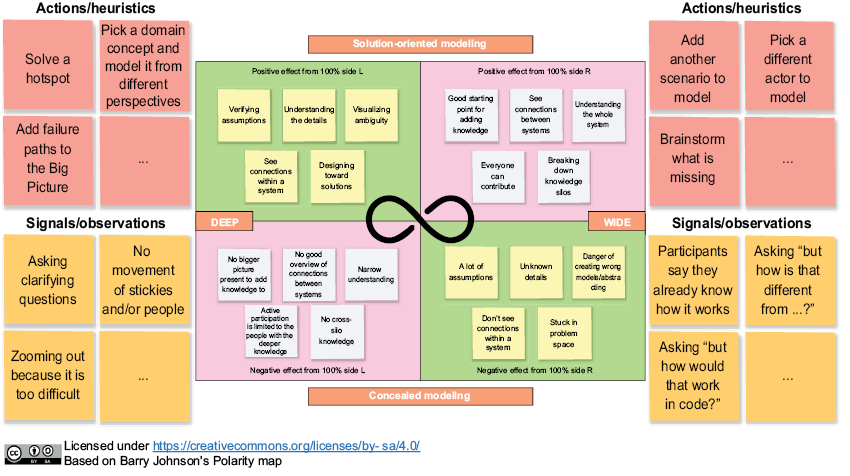
Inspect a completed polarity map to see how observations become signals and connect to actions for managing Deep versus Wide. section 10.2.2









