Supervised learning trains a model from labeled examples: each training entry carries either a class or a target value. Training adjusts model parameters to improve predictions for new inputs. section 12.1.1 section 16.4
The task is determined by the kind of output the model must predict:
- Classification predicts a category, such as an object class. section 12.1.1
- Regression predicts a value, such as an estimated goods price. section 12.1.1
- A model is selected before training; gradient descent can then optimize its parameters. section 16.4
Predicting goods prices
A regression model receives labeled examples containing known goods prices, tunes its parameters during training, and predicts prices for new inputs. section 12.1.1 section 16.4
Figure 16.17 A few approaches used in supervised machine learning. All of them use gradient descent for learning. Note that the models are arbitrarily chosen, and also for the loss functions there are other possible choices. Gradients and loss functions for neural networks are omitted for the sake of brevity. While only supervised learning is shown here, there are also clustering algorithms that leverage gradient descent.
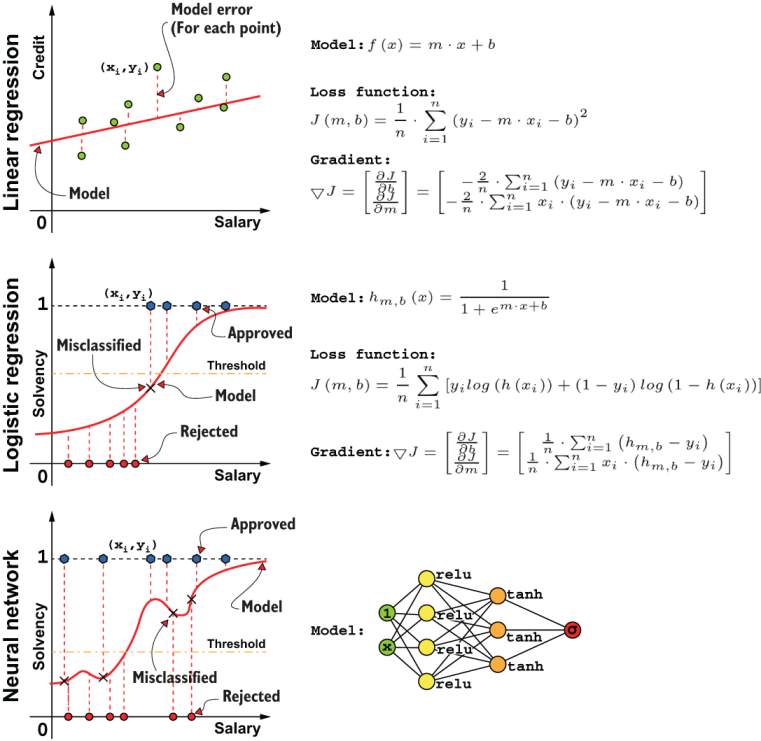
Compare supervised model types, loss functions, and gradient-based learning approaches in one overview. section 16.4


















