liveBook · Manning

Supervised learning

As explained in Classic Computer Science Problems in Swift: Essential techniques for practicing programmers

Supervised learning is a machine-learning approach that learns from inputs paired with known target outputs.

Supervised learning trains a model with inputs paired with known target outputs. The model compares its actual output with the expected answer, measures the error, and adjusts itself for future inputs. section 7.2

A neural network uses supervision to:

  • Calculate the error between an actual output and its expected output. section 7.2
  • Spread responsibility for that error through output and hidden layers. section 7.2
  • Update weights using the calculated deltas, prior inputs, prior weights, and a learning rate. section 7.2
Figure 7.4. The mechanism by which an output neuron’s delta is calculated during the backpropagation phase of training
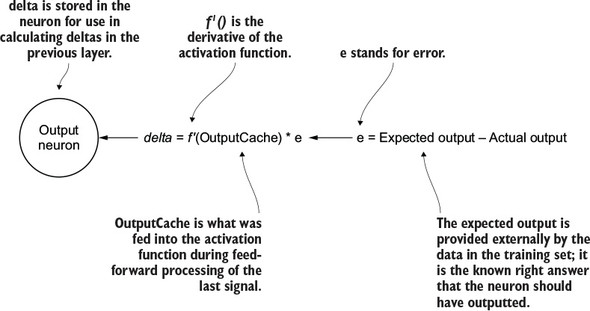
Trace how backpropagation calculates an output neuron's delta from its error and activation behavior. section 7.2


How Classic Computer Science Problems in Swift: Essential techniques for practicing programmers covers it

How deep it goes
Explains error calculation, deltas, and weight updates, but defers the calculus derivation of partial derivatives.
Examples
Uses neural-network output errors, output-layer deltas, hidden-layer deltas, and weight updates as worked mechanisms.
What it assumes
Requires inputs paired with known expected outputs and distinguishes this setup from learning without outside intervention.
What you can do after
Evaluate/understand how labeled examples drive neural-network error calculation and weight adjustment.
How it connects
Connects neural networks and backpropagation with unsupervised learning and k-means clustering.

Also explained in

Compare how 19 books explain supervised learning →

Related concepts

This explainer was generated by Manning's knowledge graph from the text of Classic Computer Science Problems in Swift: Essential techniques for practicing programmers. The section links point to the parts of the book it draws on.
















