A Transformer is a sequence-to-sequence neural architecture built around attention. Its central advantage is contextual processing: rather than carrying information forward one token at a time, it can relate positions across a sequence and focus on the parts most relevant to each prediction. This supports the large-scale language models used for generation, classification, translation, and semantic search. section 1.5 section 2.0 section 2.1
The original design has two towers. An encoder turns an input sequence into contextual representations, while a decoder uses those representations to produce an output sequence. Self-attention operates at the core of both, allowing many parts of an input or output sequence to be considered concurrently. section 2.2 section 2.5
A typical Transformer processing path combines these components:
- Input embeddings convert text tokens into high-dimensional numerical vectors that carry semantic and syntactic information. section 2.2
- Positional encoding preserves token order, which attention alone does not supply. section 2.5
- Self-attention weighs relationships among tokens, helping capture dependencies between distant words. section 2.1 section 2.5
- Multi-head attention considers relationships through multiple views, broadening the contextual signal. section 2.0 section 2.5
- Decoder models generate output sequences using self-attention, cross-attention, and feed-forward networks. section 2.5
Parallel context versus sequential state
For “The quick brown fox jumps over the lazy dog,” an RNN or GRU processes words in order while maintaining a hidden state. A Transformer processes the sentence in parallel and uses self-attention to identify relevant word relationships, making distant dependencies easier to represent. section 2.1
Figure 2.2 The interplay of the Transformer Architecture lies in two towers, the Encoder and Decoder layers which are made up of numerous layers.
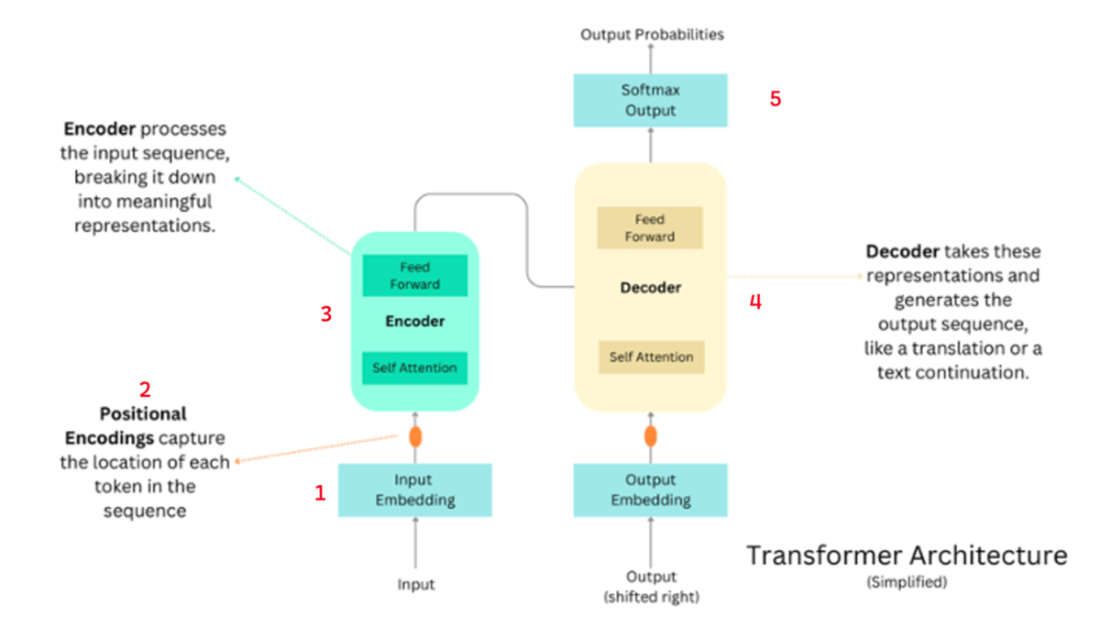
Use the encoder-decoder diagram to orient the two stacked towers before tracing embeddings, attention, contextual representations, and generated outputs. section 2.2
This design addresses recurrent models’ difficulty with long-range dependencies, sequential computation, and unstable vanishing or exploding gradients. Encoder-only, decoder-only, and encoder-decoder variants can then be selected according to whether a task needs representations, generated sequences, or both. section 2.1 section 2.5







































