A transformer is a deep-learning architecture built entirely around attention layers, without recurrent connections. For a sequence, self-attention assigns coefficients to its elements, indicating how much each element should influence predicted outputs. Multiple self-attention layers form multi-head attention; their concatenated features let the model attend to different parts of a sequence in different proportions. section 4.3.4 section 4.3.4
Figure 4.19 Transformer model architecture containing multi-head attention layers that use attention mechanism only to extract complex information from input sequence.
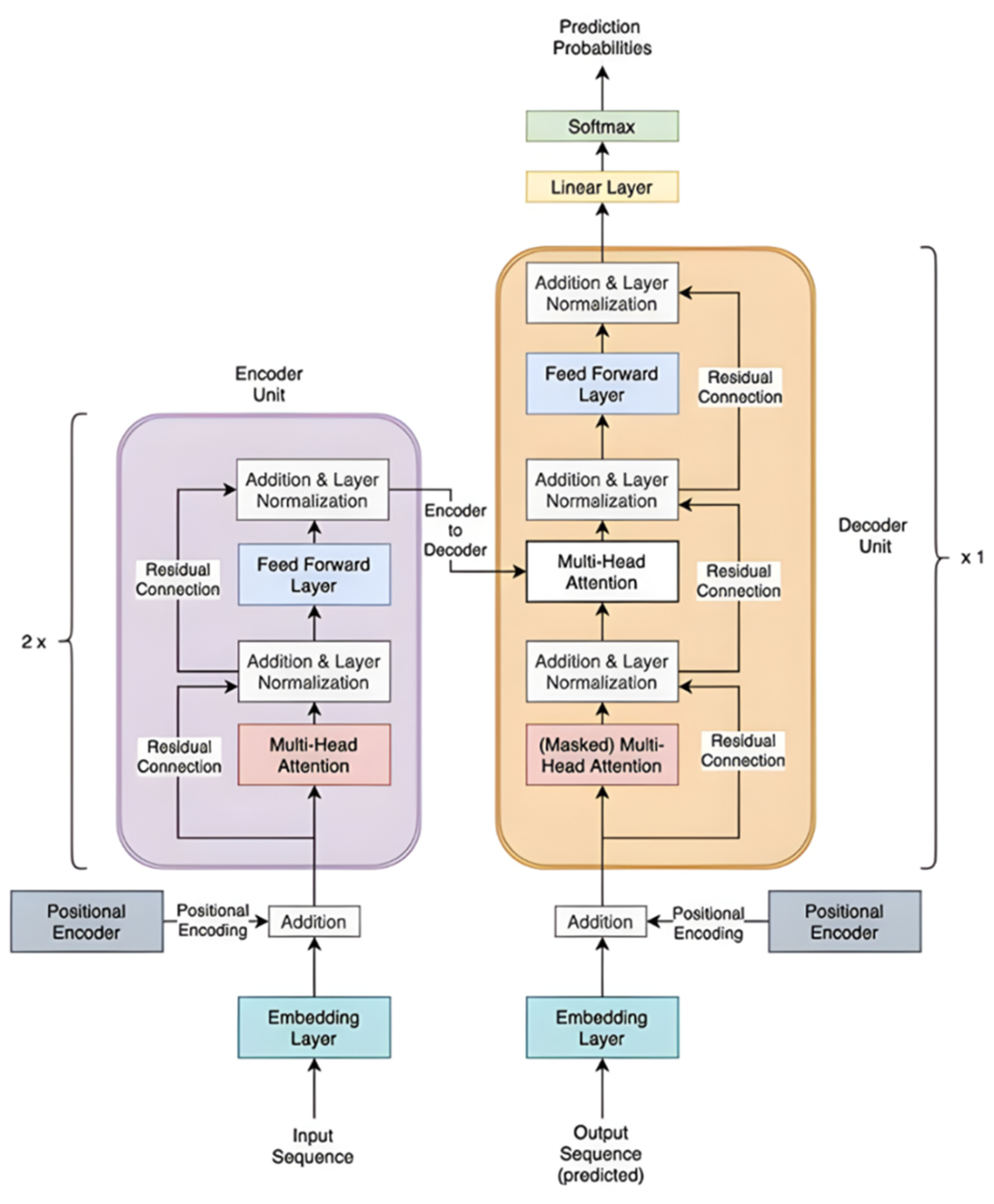
The architecture diagram highlights repeated multi-head attention layers as the mechanism used to extract complex information from an input sequence. section 4.3.4
Attention replaced the earlier pattern of adding an attention layer after a recurrent layer: rather than carry information through recurrent time-step connections, a transformer uses attention alone. Repeating multi-head attention layers produces increasingly rich representations for complex prediction problems. section 4.3.4
Translation with an encoder and decoder
For English-to-French translation, an encoder receives an English sentence after its words are converted into numeric token vectors. It passes the resulting representation to a decoder, which generates the corresponding French sentence. This encoder–decoder arrangement is a simplified transformer architecture for translation. section 5.2.1 section 5.2.1
Transformers are deployed across fraud-focused tasks and data types:
- Text-based phishing detection can use GPT, a transformer trained on large volumes of text for next-word language modeling. section 5.0
- Vision transformers support visual tasks such as extracting information from identity documents during KYC automation. section 4.4
- Transformer models can classify processed audio as real or fake for voice-faking detection. section 8.0 section 8.2
Figure 8.7 Steps in building, training, validating, and testing a transformer-based voice faking detection model.
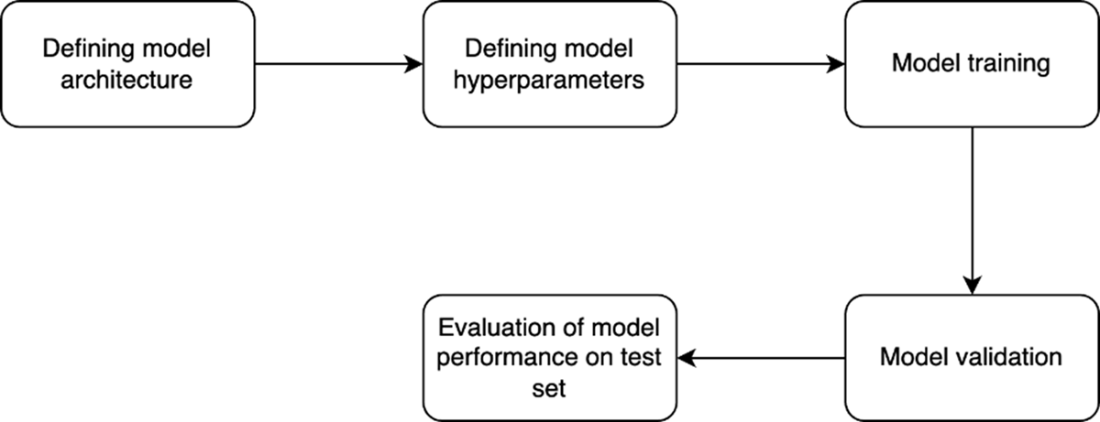
The workflow connects a transformer classifier to practical training: define layers and forward pass, set hyperparameters, train and validate, then test on untouched data. section 8.2







































