Uncertainty describes incomplete knowledge about which outcome follows an action. In decision-making, utility depends on the outcome, but an action rarely guarantees success: both success and failure can retain nonzero probability. section 12.1.1
A causal view locates uncertainty in other factors that affect variables downstream of the action. Economic conditions may influence business success, utility, or both, so statistical and probability models represent outcomes that remain outside the decision-maker’s control. section 12.1.2
Figure 12.3 We typically have uncertainty in our decision-making. From a causal perspective, uncertainty is because of other causal factors out of our control that affect variables downstream of our actions.
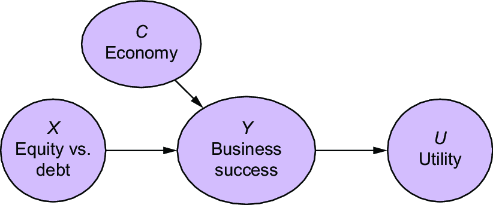
Use the causal diagram to trace how uncontrolled factors create uncertainty after an action and propagate to downstream outcomes. section 12.1.2
Uncertainty is not identical to randomness. A probabilistic model can represent uncertainty about a deterministic data-generating process, while assigning subjective probabilities to possible values or outcomes. The same modeling distinction supports Bayesian estimation, probabilistic inference, and Bayesian decision theory. section 2.4
Counterfactual decisions
After choosing one option, the rejected option’s outcome is usually not known with complete accuracy. Probability can model that counterfactual uncertainty, allowing regret analysis to compare policies and improve future decisions. section 8.1.4









