Uncertainty is the lack of complete confidence about an AI system’s value, state, or outcome. Because AI products accept open-ended inputs and can produce different or incorrect outputs, product work must treat uncertainty as a design and delivery condition rather than an exception. section 10.0 section 1.5
Manage uncertainty through coordinated product practices:
- Gather evidence and choose deliberately between careful validation and fast experimentation, balancing risk, speed, and adaptability. section 2.3
- Design interfaces that signal AI activity, communicate limitations, show confidence information, and let users modify or reject outputs. section 10.4
- Prototype and test likely failures, then collect explicit and implicit feedback after launch to uncover unanticipated situations and behaviors. section 10.4
- Align data science, engineering, UX, and domain expertise around user-centered outcomes while learning collectively through experimentation. section 12.1
A trustworthy AI feature
A team validating an AI feature simulates incorrect and unpredictable outputs instead of testing only successful cases. The interface indicates when AI is processing information, presents confidence signals, and gives users control to revise or reject results. Post-launch feedback continues the learning loop. section 10.0 section 10.4
Figure 2.9 When to be careful versus fast: comparing the ready, aim, fire and ready, fire, aim approaches
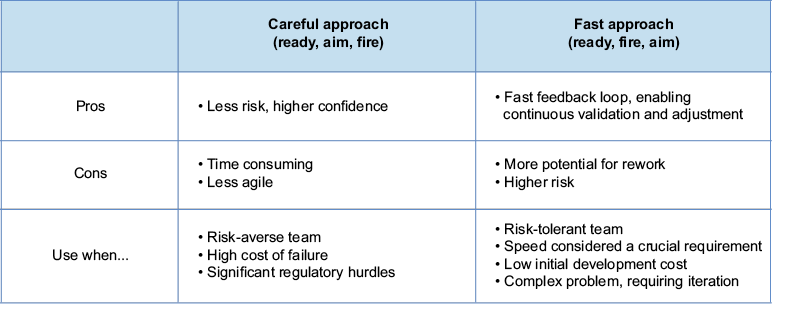
Compare careful and fast experimentation approaches for managing uncertainty, risk, and adaptability. section 2.3









