Uncertainty is the gap between what a decision needs and what people know or trust about the available information. Lower uncertainty by gathering the right information, not simply more information; this makes alternatives easier to evaluate. section 9.1.3
Uncertainty is not risk. Risk applies when possible outcomes are known and their likelihoods can be expressed as probabilities; uncertainty applies when outcomes or relevant information are still unknown. section 9.1.3
Use uncertainty as a facilitation signal during collaborative modeling:
- Make the current state a visible alternative so keeping things unchanged can be consciously compared with proposed options. section 9.1.3
- Mark uncertain areas as hotspots and investigate them before committing to a design decision. section 9.1.3
- Track whether participants’ confidence rises as new information emerges; little movement suggests exploring a different hotspot. section 9.1.3
- Create repeated feedback loops, use their information to adjust the model, and avoid continuing with a model that is not working. section 11.3.1
Choosing a boundary
When a team must decide where to place a boundary, it can proceed with a heuristic while explicitly recognizing uncertainty. Feedback from successive modeling loops supplies information, allowing the team to revisit the boundary and revise its model rather than treating the first choice as final. section 11.3.1 section 11.7
Figure 9.2 Tracking the confidence of participants during collaborative modeling is a great way to know if the information they are getting out of the sessions is valuable. In this example, we show the confidence of Kala, one of the participants. The more she discovered about the domain, the higher her confidence was.
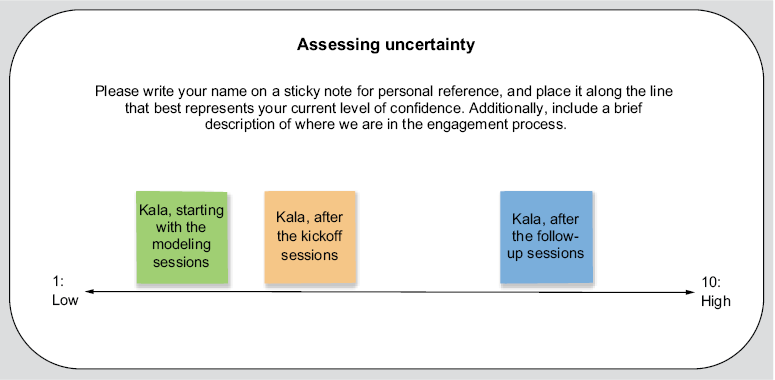
Use the confidence trend to discuss whether discoveries are reducing uncertainty for participants and whether the session is investigating a valuable area. section 9.1.3
Uncertainty cannot be eliminated completely. Sustainable decisions remain open to challenge: new perspectives, requirements, and feedback may justify redesign, while emotional attachment and biases can block necessary change. section 11.7









