User experience is the quality of using a product or service: how easily, effectively, and pleasantly people accomplish their goals. For an engineering platform, it is the self-serve path that lets development teams create, test, deploy, and operate software without unnecessary friction while meeting quality, security, and compliance requirements. section 2.1
Treating software as a product makes experience a continuous responsibility rather than a one-time delivery milestone. Features that are not self-serve, or technologies that make change expensive, undermine the product model because customers value ongoing improvement and ease of use. section 2.1
Design the experience around these operating principles:
- Distinguish stakeholders from customers, then satisfy stakeholder needs without degrading the platform customer experience. section 2.4
- Optimize the complete product lifecycle, from ideation through platform operation, instead of optimizing isolated teams, technologies, or departments. section 2.4
- Test fundamental experiences early with alpha-users, measure expected value, and use feedback to guide evolutionary change. section 2.4
- Treat frequent cross-team coordination as a warning that domain boundaries or service interfaces are creating unnecessary friction. section 2.4 section 1.3.2
A fragmented developer platform
Teams using Kubernetes, Terraform, and Git may still experience a poor platform when implementations serve a small provider group, lack user input, or are divided across traditional IT silos. Limited API access, absent self-service, and long change delays make adoption difficult even when the underlying technologies are widely available. section 6.1
Figure 1.4 Eight principal product domains within an engineering platform. The numbers by the domain indicate an underlying dependency ordering when launching a new platform.
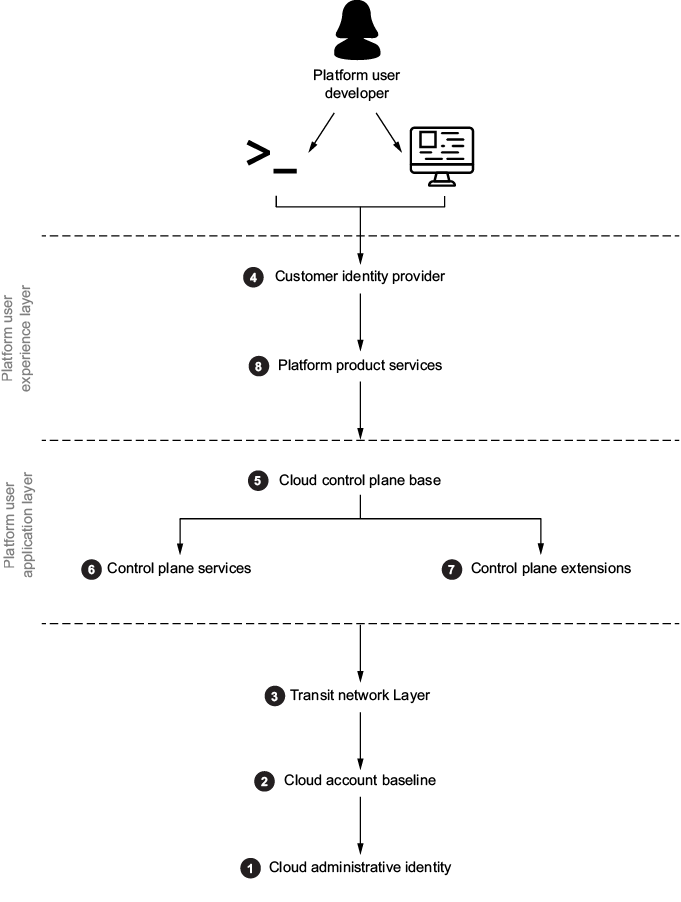
Use the domain map to relate smooth user experience to platform boundaries, dependencies, and independently owned product areas. section 1.3.2










