User experience is the overall quality of a person’s interaction with a software product. It includes whether the product meets user needs, feels usable, and behaves in a helpful way. Designing it means putting users at the center before implementation begins. section 3.4
Develop a user experience through a small, practical workflow:
- State the app concept clearly. section 3.1
- Define requirements, including what the app will and will not do. section 3.1
- Sketch the intended experience with diagrams or simple mocks. section 3.1 section 3.4.1
- Work backward from the user experience when planning components and implementation. section 3.4
- Launch, gather user feedback, and refine the design. section 3.7 section 3.1
Unit converter
A unit converter initially required users to press Convert. Removing that button made changing the value or decimal places update the result instantly, improving the app flow. The change illustrates how user feedback and observation can reveal a usability improvement after implementation. section 3.7.2 section 3.7
Figure 3.2 A mock-up of the unit conversion app
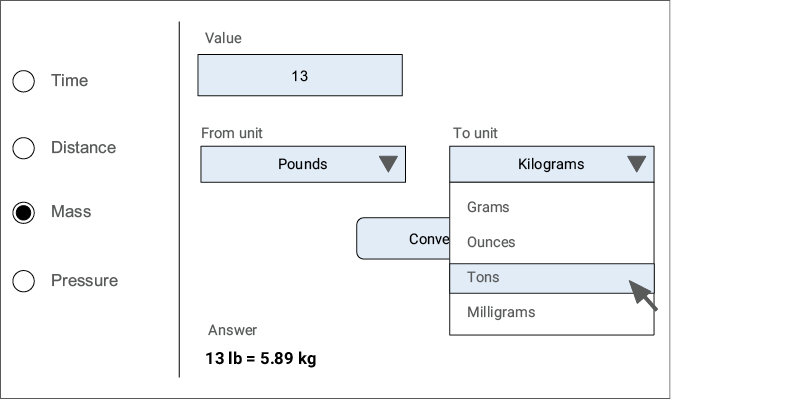
Use a rough mock to make the desired interface concrete, show the user’s path, and expose design decisions before coding. section 3.4.1










