Authentication verifies a user, application, or service before granting access. In a .NET MAUI app, it secures communication with a cloud API and keeps login logic out of the UI by placing it in an authentication service. section 8.4 section 8.0
A practical login flow separates interface behavior from authentication work:
- Define an IAuthService interface with an asynchronous LoginAsync method. section 8.1.1
- Use a mock service during UI development; the supplied implementation returns a successful result without authenticating API calls. section 8.1.1
- Disable the login button, show progress, await the service, and display an error when login fails. section 8.1.1
- Show the login page automatically at startup as a modal page, then remove it programmatically after successful login. section 8.1.1
MauiStockTake login flow
The app starts with LoginPage pushed modally over the existing Shell. Its Login button calls IAuthService.LoginAsync rather than performing authentication in the event handler. A successful result pops the modal page and reveals the application; a failure restores the button and shows an alert. section 8.1.1 section 8.4
Figure 8.1 The LoginPage has a login button. This button triggers an event handler in the code-behind file. The event handler doesn’t handle the process of logging in itself; instead, it calls a Login method in an authentication service.
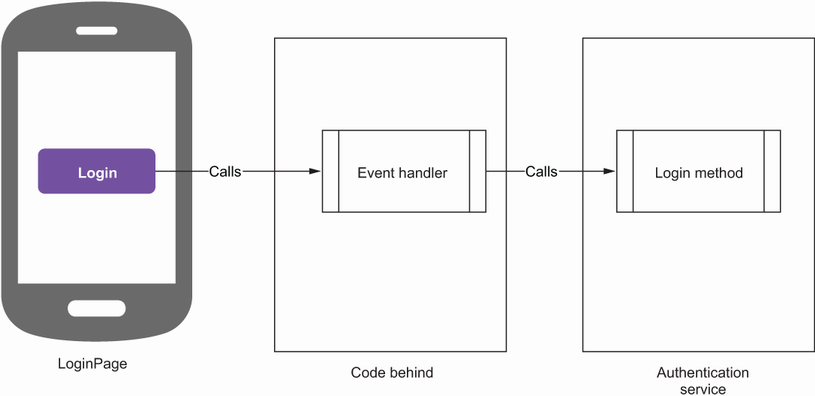
Use the interaction diagram to trace how a login button event delegates authentication to a service instead of handling it in the page. section 8.1.1

































