An autoencoder learns about data by trying to reconstruct it, rather than classify it. Its encoder compresses an input into a latent representation; its decoder uses that representation to reconstruct the input. A narrow bottleneck encourages the network to retain patterns that define the data and discard incidental detail. section 3.4.5
This makes the autoencoder a representation learner: successful reconstruction suggests the latent code captures useful structure, such as the layout of a face or the shape of a digit. Unlike an architecture designed around spatial or sequential patterns, it is organized around compression and reconstruction. section 3.4.5 section 3.4.7
Compressed representations can support:
- Removing noise from corrupted images or audio. section 3.4.5
- Spotting unusual patterns against normal behavior. section 3.4.5
- Reducing complex data to fewer meaningful dimensions. section 3.4.5
Figure 3.16 An autoencoder compresses input into a compact internal code and then reconstructs it. The encoder reduces the data to a low-dimensional representation in the bottleneck, where only the most informative patterns remain. The decoder expands this representation back into the original space, producing an output that resembles the input. By learning to rebuild the data from such a constrained description, the network discovers the underlying structure that defines the input instead of its incidental details.
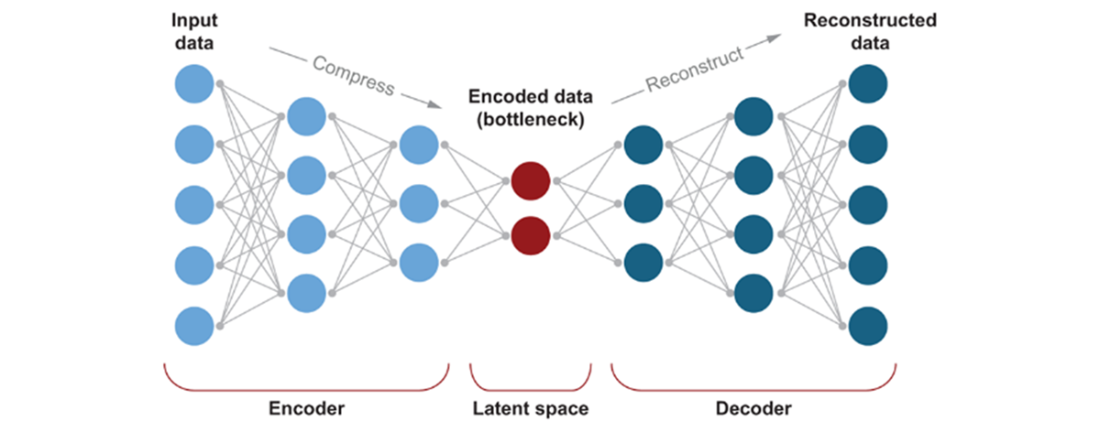
The figure traces the encoder’s compression into a bottleneck and the decoder’s reconstruction, showing how the constraint encourages the network to retain informative patterns. section 3.4.5














