Suppose an e-commerce feature is associated with higher sales. The practical question is not whether the numbers move together, but whether changing the feature would change sales. Statistical correlation alone cannot answer that question: causal inference adds assumptions about how the data was generated and asks what an intervention would do. section 1.3.1 section 1.1
An intervention changes the data-generating process. This makes causal direction meaningful where correlation is symmetric: promoting laptops might increase laptop-bag sales, while promoting bags need not increase laptop sales. A causal model must support reasoning about such changes, whether or not the intervention can be performed in real life. section 7.0
Association versus causal effect
In online gaming data, compare average purchases among players with high versus low side-quest engagement. That difference describes an observational association. The corresponding causal effect compares expected purchases under two interventions: E[purchases | do(engagement = high)] − E[purchases | do(engagement = low)]. The do notation changes the question from “Who engaged?” to “What if engagement were set to this level?” A statistical significance test can assess an estimate, but it does not by itself supply the causal interpretation. section 7.4.5 section 7.0
To turn an association into a defensible causal estimate:
- Specify the intervention and target quantity. An average treatment effect compares intervention outcomes across a population; a conditional average treatment effect makes that comparison within a segment. section 1.0 section 7.4
- Represent relevant causes in a causal model, then check identification. Backdoor, front-door, and instrumental-variable estimands rely on different causal assumptions; choose one whose assumptions are credible for the problem. section 11.7
- Estimate the identified quantity and assess uncertainty. Regression, propensity-score methods, or machine-learning estimators may be appropriate, but an association measure acquires a causal interpretation only in an interventional context supported by the assumptions. section 11.7 section 7.4.6
Causal reasoning also shapes model design. An ad model that predicts purchases from impressions differs from one that represents impressions driving engagement and engagement driving purchases. Modeling those links can make a system more decomposable and help examine what may change when it is deployed in a different environment. The links still require domain knowledge and causal assumptions; predictive performance alone does not establish them. section 1.3.3 section 1.1
Figure 1.2 A model that captures how ad impressions drive engagement, which in turn drives purchases. This model decomposes into {ad impression, engagement} and {engagement, purchase}.
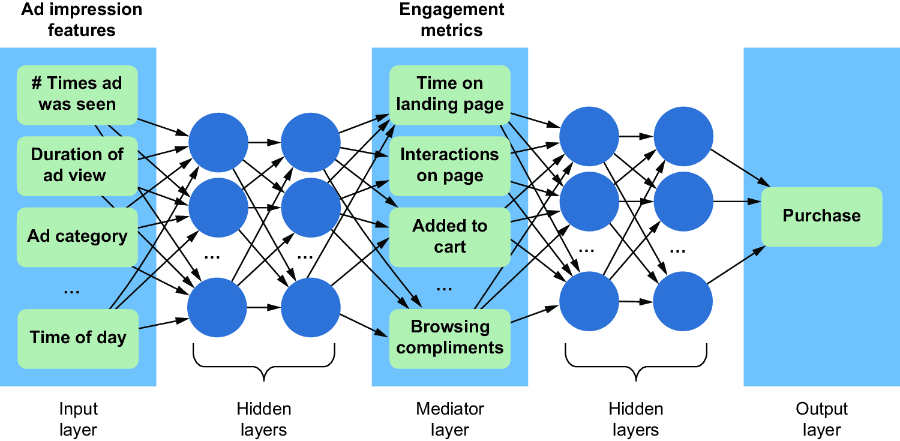
The diagram makes the proposed direction explicit: ad impressions drive engagement, which in turn drives purchases. section 1.3.3







