liveBook · Manning

Agent orchestration

As explained in Grokking Software Architecture

Orchestration is the coordination of multiple tasks or operations by a central service that directs when other services act.

Orchestration coordinates tasks by directing when other services act. In a layered application, it belongs in the Application Layer, where it coordinates work without absorbing business rules or HTTP and database concerns. section 4.7.4

In distributed systems, synchronous orchestration has a tradeoff: a central service can direct a sequence of actions, but services must be available at the same time. A delay or failure can topple the chain. Choreography offers a different approach, with services reacting independently to events. section 7.1

Figure 7.1 The Distributed Monolith: When services are coupled in time, a failure at the bottom of the chain topples everything above it.
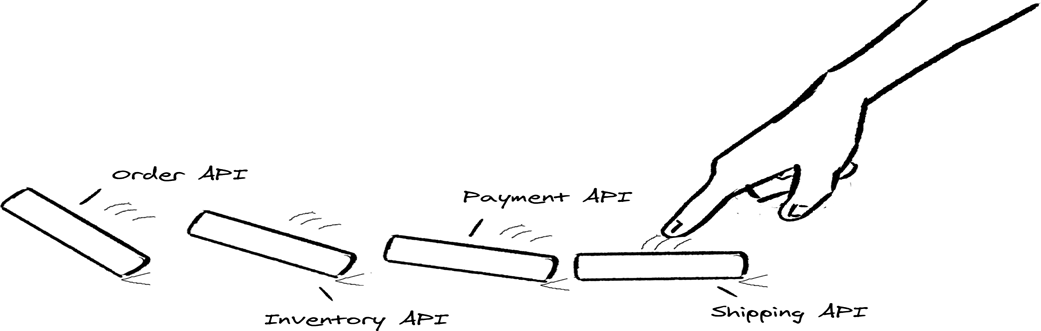
The domino-chain diagram illustrates how a failure in one service can affect the rest of a synchronously coupled system. section 7.1


How Grokking Software Architecture covers it

How deep it goes
Defines orchestration and its architectural placement, then notes distributed-system brittleness without detailing implementation.
Examples
Uses an orchestra conductor, a domino chain, and a phone call to illustrate centralized and synchronous coordination.
What you can do after
Evaluate where coordination belongs and recognize the availability risks of synchronous service interactions.
How it connects
Connects orchestration to the Application Layer, Domain Model, Temporal Coupling, and Choreography.

Also explained in

Compare how 19 books explain agent orchestration →

Related concepts

This explainer was generated by Manning's knowledge graph from the text of Grokking Software Architecture. The section links point to the parts of the book it draws on.
















