A convolutional neural network (CNN) learns visual patterns from images using convolutional layers rather than only dense layers. Small kernels slide across an image: each kernel multiplies a local image region element by element, sums the results, and produces a feature-map value. Feature maps encode increasingly high-level visual features. section 4.3.1
A typical image-classification pipeline alternates convolutional layers with pooling layers, which compress feature maps, then flattens the resulting matrices into a 1D vector for classification. CNNs use weight sharing, automatic feature extraction, and hierarchical learning, making them suited to visual-data tasks. section 4.3.1 section 4.4
CNNs support fraud-focused visual workflows such as:
- Classifying images, detecting objects, generating images, or segmenting regions within an image. section 4.3.1
- Detecting tampering in document images; segmentation can return pixel-wise forgery regions, making a prediction easier to inspect than a document-level classification alone. section 4.4 section 6.2
- Producing face embeddings inside a Siamese network, then comparing paired embeddings with cosine similarity for duplicate or identity matching. section 7.2.2
From digit image to fraud region
A LeNet-inspired CNN classifies a handwritten 7 by convolving filters over the digit image and turning learned feature maps into a class prediction. For receipt forgery, a CNN-based DeepLabV3 instead segments suspicious image regions. Its atrous convolutions capture information at multiple scales without losing resolution, while atrous spatial pyramid pooling applies several dilation rates. section 4.3.1 section 6.2
Figure 4.15 Toy CNN model inspired by LeNet model to classify handwritten digits (0 to 9).
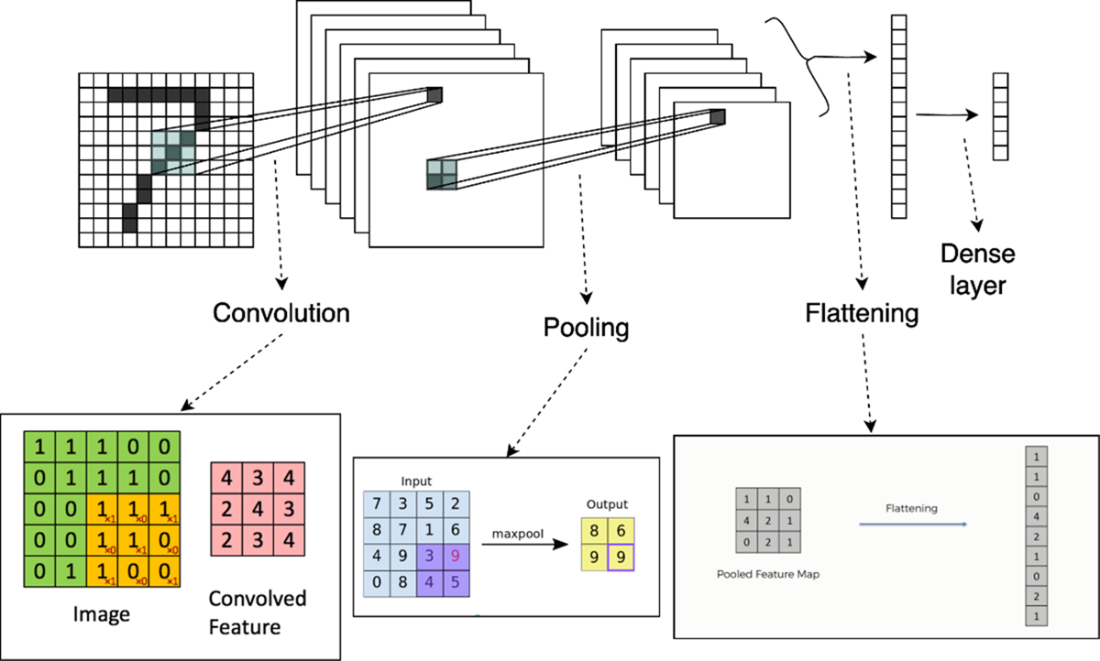
Inspect the toy digit classifier to see kernels, feature maps, pooling, flattening, and classification arranged in one CNN pipeline. section 4.3.1




















